
The New York City solution represents yet another instance of subjective perception and stubbornness over-ruling uncompromised investigation. Intellectual resources are often allocated for justifications uninhibited by investigative stagnation, decades of failure, and a profound deficit of information. We distort, manipulate, and cherry pick available evidence, serving the ultimate end of personal satisfaction over solving someone else’s puzzle. In one breath we say “only a casque proves an answer” while those who have never found one are dictating unconditional terms of their retrieval…which seems contradictory. A strict adherence to “insider” information 43 years removed from the origin and based on unknown source content is prioritized over actually solving the puzzles. We place all of our proverbial eggs into one basket when the refrigerator we don’t perceive is just out of view. All we have to do is turn our head slightly yet defiantly deny its existence without bothering even a peak.
Image 3, when applied to Roanoke Island North Carolina, has always presented an alarming condition of contradiction and incompleteness compared to the prevailing operational model. Why incorporate so much visual information for a comerically under-develeoped location paired with one of the longest verses in the entire puzzle? Why is interpretive futility regarding 80% of visual devices deemed “obvious” of correct application? Why do three flashy matches substitute for a more comprehensive application of otherwise enigmatic devices? Why would an image of stone and metal structures offer adequate representation of a location dominated by coastal waters, lush forests, and rolling sand dunes? Why does the image fail to consistently compliment the verse? Something isn’t right. For a more comprehensive commentary on the situation, click here.
The only visual elements that decisively draw attention to Dare County North Carolina are the accurate coordinates, the inaccurate representation of Roanoke Island etched into the castle wall, and the peaked window corresponding to the verse. That’s it. All other matches are incidental and circumstantial…which is not remotely indicative of the “confirmed” cases for those who follow that standard.
If image 3 is meant alternatively to evoke the stone and steel colossus of New York Bay, what cryptically communicated elements either theoretically or decisively allude to this intention? When considering the basic characteristics of the suit of armor, we find it is a shade of tan, has what looks like a hat, and appears to be intended for a man, creating the rebus “Man-hat-tan”. Our tan hat man is stretching out his arms in the “broadest way” possible. The representation of a stone wall could serve to reference the “Stonewall Riots” which took place in Manhattan. There are in fact an OVERWHELEMING number of clear visual representations of New York City in image 3 far surpassing what the typical Roanoke association can offer.

Found directly to the left of the pedestal etched on the stone wall is a rudimentary representation of New York state. While this may just be a coincidence, it is interesting that the pedestal is “covering” what would represent the southeast portion of the state, while from a content standpoint this solution “covers” New York City which is in the same region covered by the pedestal.

Attempting to develop a persuasive argument for image 3 as NYC is however not without its drawbacks. Determined through a deductive process, the immigration focus for the New York case is Russian, as related to the Litany of the Jewels on page 21 of “The Secret“. This would subsequently require the red stone of image 3 to be a topaz although presumed to be blue in image 12. According to online sources, red topaz is certainly possible when trace amounts of chromium are present.

Since topaz is the birthstone for November, we require some allusion to the assigned birth month in the image consistent with other cases. This is typically achieved by either a timepiece or a uniform series of objects indicating the corresponding number. When a timepiece appears in an image, it is automatically assumed to indicate the birth month simply because this strategy proves successful in other cases. And yet, Byron’s subjectively crafted puzzle presents a consistent series of inconsistently applied tactics. A perceived interpretive trend ends and begins not resulting from our perception or expectation, but at Byron’s discretion. If the birth month for image 3 is November, then in theory we need to count 11 of something. Circular vent holes on the helmet’s mouth covering collectively create the sum of 11. There are also 11 points on the image 3 object we would call a mace.


Another potential point of contention is the flower, assumed to represent a carnation. Coincidentally (or not), the flower for image 12 is also white and for the most part interchangeable with image 3, although an argument can be made for the precise shapes. But then again, we accept visual devices in the images that are extremely different from their real world counterparts.

The suit of armor representing Manhattan appears within a stone structure overlooking a vague aerial phenomenon and a prominent, corona encompassed star outside of the window. The imagery presented here is intended for identifying the general side of town our investigation will take place in. Outlining the aerial phenomenon to the best of our ability achieves a shape vaguely comparable to Alaska. This shape is penetrating the celestial circle with centrally oriented star, while part of Alaska is found within the Artic Circle, representing one of two polar circles.

The star Polaris not only sits virtually fixed and inline with the North Pole, but Polaris is also featured in the state flag of Alaska. The star Polaris has also been used for navigation, which will prove to be a common theme along with exploration as the investigation progresses. Also appearing in the flag of Alaska is the “Big Dipper”, depicted as a stone wall etching beneath the New York state outline in image 3 when flipped upside down.


The question then becomes, why reference Alaska in the New York City Solution? Let’s first analyze the shape of the window which serves as a suitable counterpart to either the Brooklyn Bridge or Manhattan Bridge. On the one hand, image 3 employs the approximate shape and material of the Brooklyn Bridge with comparable arch stones and corresponding ledges found where the curved portion of the opening terminates.

On the other hand, the Manhattan Bridge offers a slightly more accurate shape, while the steel framed inner outline mimics the inner edge of rolled masonry depicted in the image 3 window. In addition, the Manhattan Bridge has a singular opening to match the image versus the twin openings of Brooklyn Bridge. It is quite possible that both bridges are evoked simultaneously for slightly different reasons.

Narrowing focus to the later, running parallel to the Manhattan bridge is Anchorage Place, sharing the same name as the Alaskan city. Within the bridge’s base structure specifically along Anchorage Place, we find arches similar to those beside the window in image 3 and ribbed columns vaguely reminiscent of the ribbed arms of the armor.

As it happens, the Brooklyn Bridge also has an “Anchorage Plaza” with a comparable arch design. In both instances, notice the presence of segmented arch stones consistent with image 3.

This imagery is intended to guide investigational efforts to the correct borough of New York. If environments depicted on either side of the “window” represent real physical locations, we would theoretically want to place ourselves within the castle environment where the most devices exist. The elements found beyond the window would then represent an opposing location removed from our intended search area, designed to orient us away from the one and toward the other.
As it happens, Anchorage Place runs parallel to the Brooklyn side of the Manhattan Bridge, while “Anchorage” is also a prominent city in Alaska. If our theoretical model prevails, the majority of our search should be conducted in Manhattan, subsequently consistent with our “man-hat-tan” visual word pun.
Alaska also provides a reference to Russian immigration given that they were the first Europeans to explore Alaska, further reinforcing the theme of exploration and our previous inclusionary choices.
To the left of the gangly humanoid figure with outstretched limbs, we find a number 4, a letter F, a scythe, a cross, and a dome all cryptically etched into the masonry backdrop. Several blocks removed from the East River in Manhattan on the Manhattan Bridge, we discover a domed church on Forsythe St (four-scythe) running parallel and immediately beside the bridge.


After interpreting this set of clues as Forsythe St, an interesting pattern immerges. This clue refers to a street. The big dipper clue refers to a street. The window in the wall refers to a bridge which contains a street. Thus far, we have a wall of clues that point to streets. Could this be a play on words and a reference to “Wall” Street?
To continue this possibility, I looked at the numbers 36 and 75, traditionally interpreted as coordinates for Roanoke. If that usage is in fact and in part a red-herring clue, could those numbers be applied toward an alternative purpose? Looking at 75th st., a section of it is found between Broadway and Amsterdam. The three streets collectively create an asymmetrical triangle eerily similar to the right arm support in image 3. 75th St itself acts as the vertical crossmember. Identical results are achievable applying 36th St. to the same formula.

In image 3, there is a pointed flange extending into the triangular space beneath the arm. This could either be nothing, or it could be pointing to something significant found in the same area on the map. As it so happens, we find the James Gordon Bennet Memorial in the corresponding map location. Upon further inspection, image 3 incorporates numerous characteristics found at the memorial, including a bell, a clock, and shares a number of striking similarities to the key. The general arch shape, the owl statues flanking each side, the heads of the striking tools, and the clapper, are all emulated by the key. The key also shows what looks like a wooden yoke, which is the head piece that supports a bell, such as the liberty bell.

Going back to 75th st, we find another memorial in the point of the triangle. This time it is a memorial to Verdi. There is really no discernable significance beyond a superficial similarity between the base of the statue and the armor’s cylindrical pedestal in image three.

Furthermore, in both the 36th St. and 75th St. cases, one side of our triangle is created by Broadway. The armor in image 3 happens to be extending it’s arms in a “broad way”. If following Broadway south, we end up at Battery Park, specifically at Castle Clinton Park, which we will see later in the puzzle. Looking at the historic control house a few steps away from the JGBM, it includes a cross pattern in the masonry around a clock that emulates the cross like pattern in the vent holes on the helmet.
The suspended, miniature humanoid figure holding the bubble encased flower serves as a blended clue. First, while the connection is arguably a little vague, the shape of the body mimics the contours of the East and Harlem Rivers around Randall’s Island. When lining up the fairy with the riverbanks, the bubble encased flower falls where Downing Stadium was previously located. This venue held a “pop” music festival and is figuratively connected to a bubble because it “pops”, making this New York City solution consistent with the bubble application from the Boston case confirmed by Secret artist John Jude Palencar.

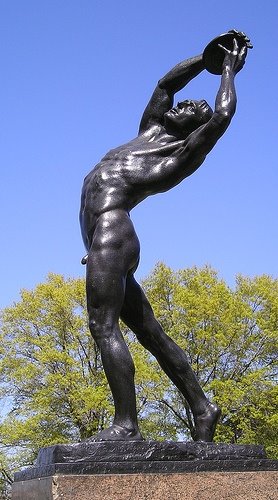
Found at the entrance to the stadium was the Discus Thrower statue, which also mimics the general posture of the fairy. Pay particular attention to the positioning of the head, positioning of the legs, and the outstretched arms holding an object. Notice also the base of the statue and how it resembles trim work on the stone wall in image 3 immediately below the fairy. Note: the below is a replica found in Athens. Click here for the original Randall’s Island version.

The scythe found on the arm of the armor in the image matches Luyster Creek, which is across the river from Riker’s Island Prison, represented by the large key ring in image 3 for it’s common association with a jail. The scythe in the image is connected to a part of the armor that makes a letter “R”, potentially standing for either Riker’s Island or Randal’s Island to the near west and previously referenced.

The key ring is depicted with a large and a small key, which is meant to represent Hell Gate and Little Hell Gate found on either side of Randall Island. The other real possibility is that the key ring represents “Hell Gate Circle” on Randall Island with both Hell Gates found on either side of the island that also starts with a letter “R”. However, the inclusion of Luyster Creek as the scythe would make less sense without a direct relationship to the other elements. We could also possibly connect the scythe to Russian immigration given the sickle that appears on the Soviet flag, although a sickle is more circular in its curvature. Red is also a prominent color in image 3, just like the Soviet flag.
Furthermore, the stomach area on the armor is a good match for Flushing Bay, found southeast of Luyster Creek.

While our image application is quite unorthodox compared to common contention, we have the same issue with the verse. For this New York City solution interpretation, we are using verse 2, which is typically used for New Orleans, given a reference to the St. Charles Hotel. This is where Byron was sneaky. He is using that line to reference New Orleans, although within a completely different context. The references to New York in verse 2 are not remotely “obvious” without investigation, but they are predominantly “clear”.
At a place where jewels abound
Fifteen rows down to the ground
This is the hardest set of lines to interpret for some reason, of which I am the least certain of. I currently have two possibilities. It is either the Riverside Park because gems are commonly found on Riverbanks and the next set of lines are found within this park, or it is a reference to the incredibly large gemstone collection at the American Museum of Natural History. The armor’s right hand forms the number 79, and if we follow the 79th St traverse through Central Park it leads to the museum. If we count the rows of block on an arch down to the ground at the historic entrance to the museum, we can count 15. If we follow 79th st to the west toward Riverside Park, we find a roundabout that matches the mace. These are extremely circumstantial connections that don’t facilitate an unquestionable starting position, but they are there.

Separately, I have considered that these lines may reference “Millionaire’s Row” on 5th Ave, but have not yet discovered a definitive connection.
They could also refer to the notable skyscraper at “15 Park Row” in the Financial District. This offers the most direct and accurate connections for my money, yet location wise puts us no where near the product of line three and the logical progression of devices proceeding it.
What should also be noted is that this case is very map-based in nature. Most matches we can make are the result of maps and history. This is how Byron can justify covering so many miles across Manhattan, simultaneously intended to mimic voyage maps of historic explorers that highlight visited places. This idea will be revisited later.
In the middle of twenty-one
From end to end
Wilbur Wright flew the Wright flyer around NYC on a 21-mile loop during the infamous 1909, 33 minute flight. He started from Governor’s Island, circled around Grant’s tomb, and then came back. So, from “end to end”, Grant’s tomb is the middle of the 21-mile flight. This fact also provides one of several connections between Roanoke and NYC. Inclusion of the Wright Flyer also fits the theme of navigation and exploration.
Only three stand watch
As the sound of friends
Fills the afternoon hours
This takes us to Marcus Garvey Park, where the last of three fire watch towers exists. The watch tower actually does ring at intervals in the afternoon and was kept by those in the neighborhood through a petition. The other watch towers were found at 33rd St. and 9th Ave., and Spring St. and Varick respectively. This reflects image 3 which shows one bell on the left separated from two bells closely paired on the right. This reference also reflects the other theme for this case: defense. Looking further at Marcus Garvey Park, the pillars around the perimeter of the park are very similar to the pedestal in image 3, and the park was once known as “Snake Hill” while what appears to be a small snake can be seen disguised as a finger on the left hand of the armor. The park was also used as a battery in the Revolutionary War, furthering the theme of defense.

This verse section presents low-ki “wed” lines with the image. We have a reference to three fire watch towers with bells which make sound, while the image shows three bells. The verse also alludes to “afternoon hours” while the one o’clock position on the time piece indicates an afternoon hour.
The secondary watch tower locations mirror the location of the two bells in image 3. Following them leads in the general direction of the next clue. The third watch tower is near the Fire Museum of New York, the contents of which can be connected to the suit of armor in many circumstantial and superficial ways. In particular, the armor’s helmet in image 3 shares interesting similarities with period fire fighting helmets, which is highly relevant to this New York City solution.

In the image, the skirt around the suit of armor mirrors the Brooklyn Naval Shipyard. This continues the theme of military, defense, and exploration. The land was originally purchased from the Canarsie Indians from a Belgium Walloon, just like Manhattan Island.

The top right portion of the skirt conceals a lobster hidden in plain site, with two separate appendages each seemingly pointing at one of the two paired bells. From a map perspective, the locations of the former watch towers not only match with the locations of the bells in image 3, but there are also underwater tunnels that seem to “point” toward those locations, further emulating image three and mirroring the aquatic nature of a lobster. Also, the USS Maine was one of the most notable vessels produced from the shipyard, while Maine is known for lobster.

These visual devices serve as reference points which compliment the verse and move us in the general direction of the next several verse lines when applying a map perspective.
During the Great Fire of New York, a detachment of Marines and Sailors were sent from the shipyard for assistance. During the Great Fire of 1845 in Lower Manhattan, a similar measure was implemented, including a detachment of sailors sent from the USS North Carolina for shore patrol. In image 3, the outline of Roanoke Island in North Carolina is scratched into the stone wall, appearing near both the bells representative of the watch towers, and the skirt representative of the Navy Shipyard, drawing an association between these devices. The silhouette of what appears to be a battleship can also be partially viewed just below the skirt, suggesting a correlating relationship between the skirt (naval yard) and silhouette (ship). This interconnects the Naval Shipyard and the fire watchtowers. The red color of the skirt also symbolically reflects its connection to fire. This illustrates the interconnectedness and pervasiveness of over-arching themes in this New York City solution.

A related visual connection to image 3 is provided by the Columbus Monument in Columbus Circle. While there are no direct ties to the verse or the path, there are however a number of interesting connections. Columbus has obvious ties to navigation, which fits one of several overarching themes of the interpretation. This monument is directly adjacent to another monument for the USS Maine, incorporated several times in the interpretation and also directly related to navigation. Then there are the clear visual connections, with the pedestal directly below Columbus emulating image 3, and the depiction of his 3 ships with only the ends exposed mirroring the shadow casted by the armor’s skirt, which in turn offers a distinct representation of the Brooklyn Naval Shipyard.

Here is a sovereign people
Who build palaces to shelter
Their heads for a night!
Common knowledge to most seasoned investigators of “The Secret“, these three lines are a quote from Abroad in America, referencing the St. Charles hotel in New Orleans. While this inclusion does serve to reference New Orleans, its not in the way the vast majority believe, instead offering a clue of confirmation for the New York City Solution. The “here” being referred to is Battery Park in NYC. During the War of 1812, American forces built multiple forts including Castle Clinton found at Battery Park and Castle Williams found on Governor’s Island where Wilbur Wright initiated his 1909 flight.
So, the people are “sovereign” because they gained their sovereignty as Americans in the Revolutionary War, and attempted to maintain their newly founded independence in the War of 1812. Building this series of additional forts was a defensive measure. The word “palace” is of course a synonym for “castle”. These forts were temporary and decommissioned shortly proceeding the war, justifying the verse’s depiction of sheltering their heads “for a night”. Castle Clinton was used for immigrant processing prior to Ellis Island, including in 1880 when NYC experienced an influx of Russian immigration. The final battle of the War of 1812 was fought in New Orleans. The inclusion of defensive forts and Battery Park further strengthens the theme of defense found in this New York City Solution. The War of 1812 inclusion also offers an alternative explanation for theoretical English imagery in image 3 asserted under Roanoke Island interpretations.
Others have noted the presence of a plus and minus sign in image 3, particularly related to “Gift Giver” commentary on the subject. One possible application that escaped my consideration was a subtle reference to the positive and negative sides of a “battery” i.e. Battery Park of NYC. Different context, same word. Credit Tim Odwyer.
Gnomes admire
Fays delight
The namesakes meeting
Near this site
Breaking down the verse on a theoretical basis, we should be looking for a site referencing two individuals who either had a meeting with each other or separate meetings of some historical significance near that location. As The Secret: A Treasure Hunt identifies “fays” as French and “gnomes” as Dutch, each figure or “namesake” should have a positive standing with the respective nationalities. Battery Park is such a location which satisfies each qualifying characteristic.
Giovanni Verrazano, whose memorial is found near Castle Clinton, was an Italian explorer working for the French and encountered the native Lenape in New York Bay at a location “near” modern Battery Park. This monument depicts Verrazano in a suit of armor without legs mounted on a stone pedestal, while image three shows a suit of armor without legs mounted on a stone pedestal. Note: the below picture shows an updated pedestal not indicative of the original version that existed in the 80s.

Earlier, we interpreted the right-hand fingers of the armor to indicate the number 79. However, if we turn the hand upside down, it looks like the letters “G” and “V” which are the initials for Giovanni Verrazano.

The armor imagery continues our theme of defensive measures, and the inclusion of Verrazano continues our exploration theme. The other historical figure is Peter Minuit, who had a famous “meeting” with the Canarsies to purchase Manhattan for some “trinkets”. (While it is possibly just a coincidence, image three is littered with “trinkets” such as a spoon, watch, key, and bells. Ironically, such “trinkets” are sold as souvenirs.) This event is depicted on a monument near the Verrazano statue and Castle Clinton. Peter Minuit Plaza is also found on the other side of Battery Park. It is important to identify that “namesakes” is plural and not possessive, meaning there is more than one “namesake” that had a “meeting” “near this site”, consistent with the interpretation. It should also be noted that the sale of Manhattan, as well as the Dutch-French fur trade, are both spoken of in The Secret: A Treasure Hunt on pages 27 and 29 respectively.
Perceiving the left hand of the armor in image 3 right-side up, we find the initials P.M….standing for Peter Minuit. Each hand therefore collectively represents our two “namesakes” spoken of in the verse.

The general configuration of our final map for the New York City solution does not provide a linear path such as are customary in the other cases. This puzzle rather seems to mimic the navigational patterns of early exploratory missions in which specific locations of great distance were visited. This in turn mimics the voyage of Giovanni Verrazano, which is alluded to in image 3 based on the loop of string held by the suit of armor, matching a loop found on the map of his route, subsequently reinforcing the suit of armor’s identity, at least in part, as Verrazano. This also connects us back to North Carolina in that Verrazano mapped the Carolina coast, visiting both Cape Fear and Pamlico Sound, leading the way for the future colonization efforts of John White on Roanoke Island.

The image shows a spoon suspended a short distance from the floor with a small round object in it, well below the pair of bells on the right side. On the map, we can find the “Pearl Diner”. The diner’s positioning compared to the two watch tower locations reasonably mimics the location of associated objects in image 3. This device works in conjunction with the bells, designed to visually bridge the considerable gap between the Battery Park interpretation of lines 8-10 and the Marcus Garvey Park interpretation of lines 5-7 found roughly 8 miles away.

The litany of the jewel clue mentions “frozen fire”, while the woman in the Verrazano statue is holding a torch of fire which is “frozen”, missing the undulating nature of a flickering flame given its metallic form. The word “royal” could refer to Verrazzano’s occupational relationship with King Francis I of France.
Blaire Preiss, one of Byron’s daughters mentioned that for the New York City solution, many items from the image could be seen at the casque location. Within the context of image 3, this is likely referring to the trinkets hanging from the suit of armor. The “bells” for example likely serve a dual purpose as bell-shaped light fixtures found near Battery Park (this fixture type did exist prior to Byron’s work according to on-line sources). The outstretched arms of the dual light pole is also reminiscent of the outstretched arms of the armor in image 3. In theory, if we match the right image devices to the right real world objects, this would subsequently signify our precise casque location. However, I have been unable to locate a decisive dig spot from this theory, likely given the near constant changes occurring at and around Battery Park over the last 43 years, and the inherent difficulty of operating exclusively from Google Maps without “boots on the ground”.

However, one possibility is found near Battery Park at Bowling Green. Bowling Green, found directly across the street from Castle Clinton Park surrounded on either side by Broadway, is the supposed location where the Lenape sold Manhattan Island to Peter Minuit for a sparse collection of trinkets. Minuit is one of the “namesakes” mentioned previously by the verse. A Bowling Green dig site would therefore incorporate both “namesakes” more directly, placing us “near” but not at Battery Park in concordance to the verse. We could then also assert a direct correlation between the “trinkets” hanging from the suit of armor in image 3 and the historic site where a series of trinkets shaped the future direction of New York.
Based on a Google Maps street view, we can easily make circumstantial matches between surrounding objects viewed from the theoretical casque site and a host of corresponding elements in the image. As previously alluded to, there are light fixtures that match the bells, a clock on the Battery Park control house connecting passengers to the Bowling Green subway station, and ribbed light poles that emulate the key, while the Netherland Monument flagpole matches the outstretched arms of the image 3 armor. An in person investigation could facilitate a more definitive conclusion.
After assessing the entirety of the evidence in this New York City Solution, an interesting correlation emerges. Consider the “fairy” that appears in image 3 and what we connect it to, and how Randal Island is the point where the East and Harlem rivers converge, or “meet”. Our casque location is at Battery Park, which is the point where the East River and the Hudson River converge or “meet”, echoing the sentiment of the verse’s final lines referencing a “meeting”.
Update 1/30/26: Recently, I have been considering the collection of numbers appearing in the verse, and what those numbers may be communicating separate from the primary path application. The Japanese translation even reports that Byron instructs us to “solve” the combination of numbers in the verse in order to decode it.
Applying this theoretical framework, the numbers 21, 15, and 3 should collectively hold some level of relevance when applied to a New York City solution…and it does. Manhattan…where the puzzle takes place and is alluded to in multiple ways…has 21 bridges…15 tunnels…and 3 waterways. These are all conduits of transportation…and are all alluded to in the solution. I desperately want to share this with the community…but they just aren’t interested, and I can’t force them to be.
New York City Solution Pros:
-Explains perpetual stagnation in NYC, New Orleans, and Roanoke cases simultaneously
-Illustrates interconnectedness between this New York City solution and other cases
-Comprehensive utilization of image devices far surpassing Roanoke Island applications
-Casque site immigration
-Significant immigration references intermittently found throughout interpretation
-Meaningful Litany of the Jewels interpretation
-Connects to The Secret: A Treasure Hunt referencing the sale of Manhattan and Dutch fur trade
-Multiple themes found consistantly throughout interpretation
-Meaningful geographic mirroring from image 3 to NYC map
-Integration of word play consistent with “confirmed” cases
-Explains language nuance of verse, including “namesakes” applied in the plural versus possessive sense
-Verse application mirrors navigation theme
-Aesthetics of image 3 thematically match to NYC
-Offers alternative although equally plausible explanation for the comments from Byron’s daughter
-Compelling interconnectedness between verse and image clues
-Applies extremely specific and accurate events to verse desriptions
-Offers alternative explanation for English imagery interpreted in image 3 resulting from War of 1812
-Through the voyage of Giovanni Verrazano, offers alternative explanation for theoretical North Carolina coast connections in image 3
-Consistent although incomplete application of “bubbles”
-Applies extremely precise formula for finding image matches when interpreting “coordinate” numbers alternatively as streets
New York City Solution Cons:
-Does not apply image 12 to NYC as the result of New York City imagery
-Does not apply verse 10 as a result of “grey giant” and “rhapsodic man”
-Unclear interpretation for first two lines of verse
-Asserts red jewel as a topaz instead of garnet
-White flower in image 12 is arguably a better match for a chrysanthemum
-Ignores time piece as signifier for birth month despite every other time piece in every other case applied successfully for this purpose
-Applies verse 2 for New York City solution despite New Orleans based quote from Abroad in America
-Only known puzzle to employ isolated geographic locations for leading to casque site versus a clearly and comprehensively communicated, linear path
-Interpretated pathway encompassing more than twelve and a half miles!
-Illustrates interconnectedness with other cases
-Applies what is often interpreted as English imagery in image 3 to Russian immigration
Leave a Reply