
Hermann Park interpretations for a seemingly obligatory Houston solution are fraught with the typical trappings and misplaced enthusiasm synonymous with popular solution proposals. Isolated one for one matches and what amounts to subjective guesses sacrificing accuracy and authenticity substitute for a compelling and comprehensive answer clearly communicated by a trained communicator. Fortress north…that’s the Houston skyline. Why…because it has to be something, right? Cold as glass…that’s Glassell Art Institute. Why…because we found the word “glass” in a name. “Through the wood, no lion fears” means an area where we don’t fear lions…which I guess is anywhere that doesn’t have lions…right? In the middle of four alike is trees. Why…because Secret investigators are obsessed with random trees. For a full run down of the typical solution proposal, see this page from PB Works.
How did we get here? Because verse 1 integrated content belonging to New York City author Herman Melville obviously leads to a Houston Texas park appropriating the same surname but with an alternative spelling. The one verse interpretation we can confidently hang our ten gallon hat on is the association between the number “982” to a decommissioned train engine bearing the same set of identifying numbers. And yet, the numbers 982 in perfect sequence inevitably exist in alternative places for alternative purposes.
On the other hand, the image offers a far more decisive although isolated set of associations. A full set of Houston coordinates are found in the trees. A single star may refer to the “Lonestar State”, although other images likewise display a single star, such as image 11. The decorative column capitol resembling a rhinoceros cranium emulates the collective shape belonging to a series of bays found along the eastern coast of Texas. The principal column with spherical capitol offers an uncanny resemblance to pathways and landscaping found at Herman Park applying either a map or aerial perspective. Any additional connection is circumstantial at best.

Navigating commonly contended clue interpretations and intermittently instituted investigational standards endorsed by the online community of Secret enthusiasts can offer a frustrating experience of contempt and contradiction. One such example is the intellectual weaponization of information from the three “confirmed” solutions, regularly mandated to reflect unconditional uniformity with the corresponding nine unconfirmed cases, neglecting the nature of subjectively crafted puzzles while ignoring counter evidence in support of sporadically applied puzzle constructs and inter-case uniqueness. Unique, alternative proposals are often unceremoniously dismissed for neglecting this vey principle, and yet, the most popular solution proposals, such as Hermann Park Houston solution, remain to be held to a comparable standard.
Hermann Park interpretations provide perfect examples of such selective deviation. In no confirmed case do we take an author’s name from one city and apply it to a park in another. In no confirmed case are we left guessing if a correct verse interpretation has been determined. In no confirmed case is the casque at or near a zoo or is a zoo involved in any capacity. In no confirmed case are any words or lines left unapplied to the physical pathway by design. In no confirmed case do four lines refer to a single environmental device. In no confirmed case does any verse line for any reason not apply to the physical path.
When initiating an investigation, I make it a point to ask questions either seldomly posed or neglected entirely. Why does verse one contain the words to assemble the book title Through the Looking Glass? Are north and south simple directional designations or do they describe a more contextual condition, possibly of a historical nature (Civil War)? How high must a fountain shoot to be considered “in the sky”, or could this be something other than a conventional fountain? Could the three column capitols in image 8 represent state capitols either current or historical? Why are the tree branches visible in frame yet the trunk is presumably out of frame? Why are there trees at all if we are in the middle of a desert? Why is a desert representative of a lush environment like Houston? Why is the sphere topped column the only one found constructed on segmented blocks versus a seamless surface? Why do the tree branches exclusively overlap the first column from the right? To some, this qualifies as “over thinking”. In reality, this represents a brand of inquiry sorely absent from Secret investigations, and could certainly explain the futility of pre-existing Houston solution proposals.

From multiple perspectives, the conventional verse and image application is simply inadequate for determining an authentic answer. If applying the frameworks and conclusions from our other investigations, such as Roanoke Island, could the Hermann Park interpretation represent an incomplete application of a much larger, more comprehensive, interesting, and distinguished picture?
With all of this being said, the following interpretations should be considered far more theoretical without a full, comprehensive solution proposal serving as corroborating evidence. It should be observed that although I am proposing an extremely unorthodox application of image 8 that integrates locations alternative to Houston, the devices that allude to a Houston solution are not being ignored entirely, but rather their intended purpose is reassigned.
When my investigation of the Houston solution began, I considered the premise that any Houston association between image and verse offered a starting point rather than an endgame. The tree that provides our full set of Houston coordinates exclusively makes contact or overlaps with the same column depicting Trinity/Galveston Bay. This visual detail is unlikely to be included on accident, suggesting that Houston connections are related solely to the column on the far right. The Houston specific details in general are sparce while the unanswerable questions remain plenteous.
Under the theoretical framework that image 8 may be intended to inspire investigation of connections between multiple municipalities, we must ask what visual information may suggest the viability of this possibility? Directing our attention to the three columns each equipped with decorative topper, it should be noted that the upper most section of a column is normally known as the “capitol”, although arguably our examples from image 8 may not qualify under typical definitions since they are not suited for supporting a structure. However, under the theoretical framework that these could be considered “capitols”, could the columns collectively indicate separate geographic locations intended to illuminate a series of systematic connections between three different “capitol” cities culminating in a final location that authenticates everything? For starters, Houston was indeed once the capitol of Texas.
Beneath the humanoid figure of the image, whom we shall refer to as a genie, is what can be considered a cyclone. The Texas Cyclone, found at the now defunct Houston amusement park Astroworld, was a replica of the Coney Island Cyclone constructed after attempts to acquire the original Coney Island coaster were abandoned. Astroworld was found along Fannin St., which also borders Hermann Park. James Fannin is depicted in portrait form with arms crossed while looking to the left, just as our genie figure of image 8 (credit Wayne Smith).

In further support of theoretical New York connections, New York City was indeed once the “capitol” of the United States. Herman Melville, who is quoted in verse 1 from his novel Pierre; ,or the Ambiguities, was a New York City author. These connections may suggest that New York City is part of the equation.
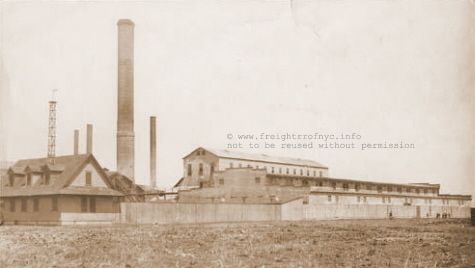
While I could spend time on the predictable rebuffs and denials for undesirable possibilities in someone else’s puzzle, let’s just see in this case where these theoretical connections take us. Let’s just say for argument sake that image 8 and verse 1 host a temporary detour through New York City. When this possibility first began emerging from the smoldering thought cauldron of analysis that is my brain, I wondered why in the world would a desert be representative of New York City? This would be a highly illogical comparison…if not for the Corona Ash Dump: an early century wasteland of fossil fuel remnants subduing the natural salt marshes of what is today the Flushing Meadows-Corona Park. A historic photograph of the Brooklyn Ash Removal company, with particular attention applied to a series of smoke stacks, offers an interesting parallel to the formation and positioning of the first four pillars of image 8 from right to left.
Perusing a modern map along the banks of the East River in Queens, geographic contours at College Point and Whitestone form a shape reminiscent of a camel similar to the one found in image 8. The northern banks of the East River form what could be figuratively qualified as a canopy, emulating in function rather than exact shape the arboreal canopy found in image 8 above the camel.

While our geographic depiction of the camel is missing a tail, slightly north across the river is a tail like peninsula suspiciously home to Fort Schuyler, offering a potential tie in with the first line of verse 1. Fort Schuyler is “north” of Fort Totten, with both armaments experiencing utilization during the Civil War between the “north” and the “south”. Throgg’s Neck, as the peninsula is officially classified, is club-like in appearance, while the camel’s tail in image 8 looks somewhat like the handle of a golf club. Directly south of Fort Schuyler across the river is Clearview Park Golf Course.
Image 8 depicts our gemstone on the crude tile surface directly below the camel’s head, while College Point representing our camel’s head on the map is directly north of Flushing Meadows-Corona Park, former home of the Corona Ash Dump as previously identified, as well as the former site of two World’s Fair events.

Several indicators have thus far steered our investigation toward FMCP. Just north of the Queens Zoo is a space program display known as Rocket Park, offering a plainly obvious connection to the Houston space program. In fact, there are a handful of interesting parallels between the two parks. They both have a zoo. They both have fountains. They both have reflection pools. They both have lakes. They both have a science center. They both have miniature trains. For you tree lovers they both have trees, and I’ll hazard a guess we can find four grouped together if we really want to.
Friendship south
If entering from 111th St. between 54th and 55th Ave, our path into the park is United Nations South. The United Nations is an organization of cooperating national governments participating in a mutually beneficial relationship for the purposes of furthering and supporting international peace, consistent with the concept of a friendship although certainly more formal and contractual. Nevertheless, this fits the verse just fine.
Through the wood
No lion fears
Upon entering the park we pass the Fantasy Forest Amusement Park. No matter what perspective is applied, whether the lack of fear is characterizing the interpreter of the message or the lion, a “fantasy forest” is certainly not a source of intense concern for personal livelihood from lions or anything else. Here we find a unique carousel formed from two retired models both salvaged from Coney Island. This same carousel appeared in the 1964 World’s Fair. Rideable companions or apparatuses include 71 horses, 2 chariots…and one “lion”. Interesting…

In the sky the water veers
Traversing over Grand Central Parkway and approaching retro-futuristic remnants of the 1964 World’s Fair, we discover a well preserved artifact in the near distance. Vital to the park’s identity both past and present is the Unisphere: a giant steel framed globe equipped with encompassing rings, tri-pod support, and a welcome although gratuitous collection of upward shooting water jets. When operational, water is both shooting and blowing into the globe. If compared to the earth itself, the water is passing through and veering into what we would consider the “sky”.

Looking to the image we have a pillar with a singular orb on top, of which we could dub a “unisphere”. Above that same pillar is a star with a corona around it, theoretically symbolic for “Corona” Park. Applying an aerial view of the fountain and connected pathways, we find a familiar configuration visually consistent with the globe topped column of image 8. However, unlike the Herman Park example, the sphere in the image aligns with a corresponding landmark of contextual relevance: the Unisphere of Corona Park.

Because Walt Disney’s presence at the 1964 World’s Fair so significantly impacted popular culture and future generations of themed entertainment as well as technological innovation, some puzzle-based allusion to his substantial contributions, although not mandatory, would be logical and warranted. Forming a pool of words by isolating lines 2, 7, and 20, we can create the title Through the Looking Glass, the sequel to Alice in Wonderland by Lewis Carrol. Historical photos from the fair show costumed characters from the 1951 Walt Disney animated Alice adaptation congregating near the entrance to “Its a Small World”.
Small of scale
Step across
Perspective should not be lost
The Unisphere is a small scale version of the Earth despite appearing in rudimentary form and lacking many obvious characteristics. If we are meant to “step across”, the question remains in which direction? Perhaps this answer is conveniently available in the very next line. If we are told that perspective should not be lost, does that mean we need to find it in order to “step across”? Northeast of the Unisphere…is a reflection pool. Gaining the correct perspective requires reflection, something that would benefit the Secret community to participate more consistently in, in particular regarding a Houston solution.

In the center of four alike
Small, split
Three winged and slight
On the western edge of the reflection pool is The Rocket Thrower: a towering monument and reverent embodiment of human space exploration through whimsical imagery indicative of 1960’s aesthetics, created for the 1964 World’s Fair consistent with the over-arching theme. The monument is illuminated by four identical light fixtures found in the corners of the concrete planter base, placing our rocket thrower perfectly in the “center”. Looking at the rocket itself, it appears to have three “wings” (I would appreciate a confirmation of this from a local), is extremely “small” and almost indistinguishable as a rocket making it “slight” by definition. The word “split” is slightly more difficult to explain. It could refer to a rocket splitting off from a shuttle during space launch. What appears to be a shuttle does appear in image 8. Focusing our attention on the metal piping the stars are attached to, we find a star in the middle of a ring with a vertical bar going through, consistent with the star appearing in image 8.

What we take to be
Our strongest tower of delight
Falls gently
Consistent with the conventional inclination whenever literary quotes are present in the verses, these lines are taken at face value, belonging to Pierre; or, the Ambiguities by Herman Melville when applying the typical Houston solution. While such consideration is generically valid, error arises when an investigative mentality is abruptly halted and silenced by a single possibility that has failed to lead to convincing results and functions incoherently.
Why must the name of a New York author lead to a Texas park with an alternative spelling? Why must three lines of the verse lead to a single statue 1100ft from our casque location we are already at serving no purpose beyond existing? What if these lines serve both as a contextual clue appropriated from a novel AND describe a specific historical, environmental device implementing the words “strongest”, “tower”, “delight”, and “falls gently”?
In addition to 1964, FMCP also hosted the 1939 iteration of the World’s Fair. One of the most notable and popular attractions featured was the Parachute Drop: an innovative contraption originally designed for military training before “delighting” Fair attendees as an “amusement” attraction and eventually Coney Island patrons following the Fair’s conclusion. If it holds up, this is the third Coney Island connection of the proposed solve.

Taking this interpretation piece by piece, we have a “tower” employed as an amusement attraction (another word for amusement is “delight”), originally conceived by Commander James H. “Strong”, “gently” lowering riders more than two hundred feet via operational parachutes. With the ability to apply four extremely specific qualifiers to the same device, its extremely difficult if not impossible to argue for the presence of a garden variety coincidence in this instance. There is also this interesting historical photo of a rider gracefully descending from an alternative parachute tower (this looks to be applied for military training), bearing a suspicious resemblance to a flower like construct appearing in image 8 on the tree branches, and offering a completely different interpretation from the typical Houston solution.


Despite a reasonable confidence in the interpretation, what intended purpose does it serve and how do we know? This proves to be a difficult question to decisively answer. The parachute drop tower had two different locations during the fair, both at a considerable distance from our current position, and was removed from the park entirely to its Coney Island location following the fair’ conclusion, which itself provides an additional Coney Island connection. Is this device intended more as a contextual clue for getting us to FMCP in the first place, or are we meant to travel clear across a large park traversing an interrupting highway overpass without additional instruction? A lack of uncertainty does not bode well.
Looking back from treasured ground
There’s the spout!
A whistle sounds
There are a number of fountains all within the same plumbing network that could qualify as our “spout”, serving to technically appease the relationship alluded to in the Japanese Translation between “water veers” and “spout”. However, the apparent lack of specific confirmation does not instill investigative confidence without additional evidence. The same can be said for the “whistle”, which could easily refer to any number of soccer fields where a whistle is intermittently heard during active play. But how do these circumstantial connections confirm our collective answer?
Take your task
Its quite common in the verses for Byron to play with line order based on ambiguous wording. Is it possible that this entry intends to instruct an active process throughout the interpretation eventually fulfilled at our conclusion? FMCP is broken into two segments by the Long Island Expressway. The southern parcel containing Meadow Lake accommodated the amusement ride section of the 1939 World’s Fair, including both locations of the Parachute Drop. Constructed on the lake’s edge is a boat house which hosts TASCA (The American Small Craft Association), founded in 1967. If the word “task” references TASCA, this could certainly reinforce a theoretical casque location somewhere around Meadow Lake near the former site of the Parachute Drop.
This brings us to a hypothetical Middle Eastern immigration reference that has thus far remained anonymous. Slightly removed from the primary path between the Unisphere and reflection pool lies the Column of Jerash, a gift from King Hussein of Jordan during the 1964 fair. While this would fulfill immigration and the general thematics of image 8, it fails to appear coherently when considering how the verse has otherwise guided our path. Perhaps as just an incidental device, but certainly not a potential casque location unless something thus far has been seriously misinterpreted.

Now that the bulk of evidence has been presented…its time to get honest and transparent. Despite some interesting connections, we also have a lot of missing information. What purpose do the words “cold as glass” serve? Where is the number 982, presumably near the boat house based on our interpretation? What does “December night” refer to? How do “spout” and “whistle” confirm our casque location beyond a generic presence? How does the puzzle narrow a more precise search grid? What do we do with numerous visual devices from image 8 that remain unaccounted for? Although this proposal may be more comprehensive than the typical Houston solution, it falls victim to many of the same issues.
What if FMCP serves as stop number dos on a three city tour, and the incomplete condition of our current interpretation lends itself to leading toward a third and final destination? Sounds wild I know…but its Byron’s puzzle isn’t it? Can he do this if he so pleases?
So, what evidence leads us to considering this possibility. As stated previously, we have three principle columns each with a specific identity potentially indicative of a “capitol” city. As it happens, the Herman Melville reference provides three points of potential communication: the author’s name, the author’s city of primary residence and subsequent story location, and the name of the novel. Directing our attention to the closest column, we find numbers etched into its base. While difficult to discern, they appear to be 58504…which is the zip code for Bismarck, the capitol of North Dakota (honestly I see different numbers at different points, but the connection is interesting). North and south are referenced in verse 1, while we have North and South Dakota. Dakota translates to the English word “friendship”. The capitol of South Dakota…is Pierre. What exact purpose this information might serve is presently more difficult to discern.

Considering our investigative stepping stones leading from a Houston solution to Queens New York, what characteristics might we strategically apply for illuminating the final piece of this vexing puzzle? Honestly, the pool of possibilities appears quite expansive. In the interest of time, let’s narrow our theoretical focus to the greater metropolitan area of Los Angeles, California, which served as a regional capitol historically under Mexican dominion. There is a shape between the camel’s legs vaguely resembling the state of California, but such a connection is circumstantial.

One detail that has always bothered me is the lack of shadow for the camel topped column, potentially suggesting some level of differentiation from the three primary elements otherwise complete with shadows. This could theoretically make sense if the camel topped column is the only example of an east coast reference for this case, representing a considerable physical distance from the other west coast geographic locations represented.

Our first two locations integrated amusement parks and attractions, while the Los Angeles area is a high profile mecca for themed entertainment enthusiasts. Disneyland is home to an Alice in Wonderland attraction, and a statue of Walt Disney with Mickey Mouse called “partners” found in front of Sleeping Beauty “Castle”. From 1976 to 1999, Knott’s Berry Farm was home to a parachute drop tower attraction. Universal Studios has their own “Unisphere”. Nothing conclusive…but interesting.
Could evoking a lion and the potential presence of fear be a reference to the Wizard of OZ which was filmed in Los Angeles, or to the MGM lion mascot that at least one version of which was tame and quite friendly?
Our ability to check boxes is also quite strong when considering Griffith Park. Not only is it home to the current zoo, but also hosts ruins of the previous zoo available for exploration, mirroring image 8 which shows arid ruins complete with animal effigies. It has a miniature train. It is home to a former landfill. It is home to the “friendship” auditorium. Forts and castles are in plenteous supply. Crystal Springs Dr. runs through the park while on page 16 of the book “crystal fountains” are evoked when speaking of the “fair folk” of Middle Eastern decent. The William Mulholland Memorial Fountain commemorates the visionary responsible for constructing the Los Angeles Aqueduct: veering across the mountain ranges of southern and central California. The fountain is directly adjacent to a soccer field where whistles are heard.

Then we have the Hollywood sign on Mt. Lee visible from the Griffith Park Observatory. While “post oaks” are commonly associated with the image 8 arboreal counter-part when a Houston solution applies a sole municipal location, the contours of their leaves are far too smooth and rounded to provide an accurate comparison. Instead, the jagged foliage of image 8 shares a far closer likeness to holly leaves…which are connected to wood branches…ergo “Holly”-“wood”. Further considering the verse 1 reference to “December”, holly is considered a birth flower for December.


What remains to be seen is how anything presented here would satisfy a Middle Eastern immigration focus, although the allusion to an American holiday with Middle Eastern origins might qualify.
All of this being said, there are simply too many puzzle characteristics either unaccounted for all together or not conclusively indicative of trained communication in the proposal’s current state, which is honestly not much better than the typical Houston solution. Can anyone crack this case? It will require a mentality seldom seen in online expressions of “Secret” enthusiasm…including but not limited to a considerable degree of honesty.
Leave a Reply