
St Louis is one of the more difficult cases to talk about, based predominantly upon an instinctual, socially manufactured aversion to the possibility. The theoretical existence for a St. Louis case of The Secret is not typically denied because of a lack of credible evidence, but rather a preconceived determination neglecting the intellectual acknowledgement of a subjectively crafted creation, and assumed reliability of unknown sources with an unknown basis for their claims (Gift Giver), exchanging objectivity for perception and preference. Belief in a St. Louis solution is characterized as wishful thinking, when in reality wishful thinking goes in more than one direction. Before I present the solution itself, I’m going to lay some groundwork. I apologize for the length. If it weren’t for all of the apologetics necessary to automatically include, this explanation could be far shorter.
Beyond supposed city/image “confirmations” provided by JJP and The “Gift Giver”, by far the most powerful hindrance to even entertaining the possibility of a St. Louis case lies within the unconditional devotion to pre-established community contentions rivaling the fervency of stereotypical religious beliefs. Its not really about what the evidence and logic mandates; its about what the online community has spent the better part of several decades assembling, and the comprehensive, ego shattering restructuring necessary if even one image and verse pairing require reassignment. Years of expletive laden, aggressive, and sarcastically asserted contentions would become intellectually obliterated. Decades of effort would be effortlessly rendered entirely arbitrary. Some would be rightly frustrated with themselves. Some would be frustrated with Byron daring to deviate from predictable and “obvious” clue applications in a “puzzle” called “The Secret”. Some would be frustrated with those who asserted superiority and dominance while misleading the masses.
Some time ago, a Q4T (Quest 4 Treasure) user named Johann reported email correspondence with Byron in which his specific St. Louis proposal was denied but the city itself was confirmed. This is from “Limey” on PB Works:
As we know, BP replied to an email by Johann of the Q4T forum (who had proposed a St. Louis solution to him), saying that it was “Very impressive work esp since the book is 20 years old. I think you deserve to know that you are correct about st. Louid,but not correct about the location. thanks for all your excellent work”. ‘st. Louid’ is likely a typo, so this almost certainly confirms a St. Louis casque. Johann said on Q4T in 2007, “I extensively explored Tower Grove Park years ago. In fact, it was my solution that I emailed to BP. He said I was correct in thinking St. Louis, but I had the wrong location. Did he mean the wrong park or the wrong spot in Tower Grove Park? I don’t know.”

While some attempt to connect the mention of “St. Louis” from Byron with the cathedral in New Orleans, why would Byron respond to a wrong proposal, in a completely wrong city, by revealing a specific location for an entirely different case? That theory doesn’t hold water. Such unspecified and unsolicited information would prove completely uninterpretable and irrelevant to the recipient submitting a proposed solution for the city in Missouri. It is my understanding that, of the thousands of enthusiast messages Byron received, only a select minority were responded to with any substance, giving the above correspondence a high degree of importance.
Ironically, the basis for a St. Louis case comes from the words of Byron himself, while the basis for denying the possibility comes in part from interpreting the claims of individuals who got any relevant information they possess from Byron 43 years ago. Why would statements from JJP or “Gift Giver” overrule direct communication from Byron himself decades prior? How is submitting a St. Louis solution and receiving a response from the puzzle’s creator stating “you are correct about st. Louid” disqualified as a “confirmation”? It’s disqualified solely for failing to conform with the artificially engineered narrative of the community.
As it stands, subjective expectations overrule Byron’s own words. Eight of the nine remaining images incorporate precise geographic coordinates for the suspected cities, while image 10 utilizes the Mill-walk-key rebus, supplemented with an isolated collection of additional visual confirmations in each respective case. By conventional measurements, this condition solidifies those referenced cities as holding a casque, when logic and evidence in a subjectively crafted puzzle mandates no such automatic condition. Can geographic locations be visually represented in the images WITHOUT automatically leading to a casque there? Decades of dead ends might warrant some consideration.
Is it possible that a city could be visually referenced for a purpose other than leading to a casque? Why not? Cities do not exist in a bubble but rather have interconnected histories and relationships. What is stopping Byron from referencing more than one city in a single image? Would this be a clever way to not only inject misdirection thus increasing the difficulty, but simultaneously lead to the correct answer with an unanticipated relationship? For example, this theoretical condition would satisfy the co-existence of Montreal and St. Louis related imagery or symbolic devices within a single image, specifically image 9.
In Secret cases of confidently asserted city associations, two to three pieces of evidence are repetitiously sighted while the remaining, neglected sum offers more holes than a piercing enthusiast. While image 9 offers a relatively healthy collection of Montreal indicators such as accurate coordinates, geographic matches, and the now infamous “legeater”, a compelling and comprehensive verse interpretation to compliment visual elements remains elusive. In fact, most proposed Montreal verse applications struggle applying image elements beyond generic, face value matches. A proposal of growing popularity applies image 9 visual devices toward the active solve a grand total of four times. What could be the reason for that?
Investigators typically narrow their focus to superficial one-for-one matches neglecting symbolism, wordplay, or other communicative devices evident in alternative, confirmed cases. Why don’t we for example do anything with the checker board beyond associate the Golden Square Mile neighborhood (another image has a golden square btw)? A checker board may symbolize opposing forces. In addition, the principle figure in image 9 appears in an asymmetrical format, where splitting him down the middle and mirroring each side produces two unique vestiges, possibly indicating multiple “personalities”. Taking both devices into account, we have the possibility of opposing forces and multiple identities…hang onto that for later.
The question becomes this: if visual Montreal references can ONLY lead to a Montreal casque in a subjective puzzle of variable difficulty and “blatant” misdirection, who told Byron? Taking a far less binary approach honoring the subjective nature of this puzzle’s creation, while perceiving the symbolism of a checkerboard representing opposing forces and an asymmetrical figure representing multiple identities, we can investigate the references to Montreal within an entirely different context, leading ultimately to a different casque city applying image 9 and verse 5. To understand how Montreal can work without image 9 or verse 5, click here.
On the left side of the man’s tunic is the image of a flower. This flower represents October (reportedly a “cosmos”), has 11 full petals, includes the number “67” and a musical note, and is imposed over a checkerboard backdrop with a variety of Montreal references scattered throughout. The St. Louis Blues (their insignia is a musical note) played their first game at the “Checker” dome on October 11th, 1967.

That same year they appeared in the Stanley Cup Finals…against the Montreal Canadiens, fulfilling the checkboard symbolism as well as Montreal inclusions to the fullest degree possible. This interpretation allows us to apply a whole host of visual devices…to a singular event. From a perspective of statistical probabilities, how could we possibly argue this is the product of a coincidence?

Continuing with a St. Louis solution applied to the image, we can establish instances of thematic continuity, a whole host of geographic matches, and clear visual parallels to Forest Park landmarks. However, asserting an alternative identity for image 9 requires immediate explanation for the “legeater”, accurately representing the lamp post base design found at the Mount Stephen Hotel on Rue Drummond in Montreal. While a one for one match is effortlessly made, there remains a host of lingering and unaddressed questions. Why does a portion of the leg appear outside of the square? Why does what appears to resemble a heart seemingly appear in the joint of the leg? What is the structure included in the square and immediately to the right? Why did this same structure replace a fleur-de-lis that Byron felt was too obvious? I have a few thoughts.

First of all, a very similar design does exist somewhere else, for unknown reasons, in an entirely different form, and just as important, can answer all of these otherwise looming uncertainties. A suspiciously similar shape exists at Forest Park in St. Louis, and is created from paths and roads at the park. Even specific characteristics of the leg eater are emulated within the interconnected pathways, such as the point of the ear or the placement of a triangular median matching the nose. The shape extends beyond the park’s current boundaries forming a “leg”, which in reality is Hudlin Park (formerly a part of Forest Park cut off by the extension of the highway), much like what is shown in image 9. The leg joint with what looks like a heart matches the location of Hospital Dr., with the Cardiac Ward of Barnes-Jewish Hospital directly across the street from Hudlin Park. There is even a parking garage at Hudlin Park that directly connects to the Hospital.

While many if not most will find the “legeater” interpretation unsatisfying, let’s address some facts. The roads and pathways existed during the applicable time period, and either a park map or aerial view would have been just as accessible if not more so than obscure information sources we know with certainty are involved in the puzzles. Unlike the “legeater” in Montreal, this interpretation addresses pertinent details, including why the leg extends beyond the box otherwise encapsulating it. This interpretation also draws a logical association to the other objects appearing on the man, which will be made evident momentarily.
While difficult to identify definitively, the peculiar geometric pattern appearing next to the “legeater” shares comparable contours with buildings of the Barnes Jewish Hospital complex, in particular with a structure directly across from Huddlin Park, and would certainly fit well with the interpretation.
An original version of image 9 shows a fleur-de-lis in place of the geometric structure beside the “legeater”. Then the question becomes why cover up the fleur-de-lis? It is reported that Byron felt the reference was too “obvious” although the image is a pretty generic symbol connected to many cities and institutions. Why would Byron consider a generic symbol appearing many places to be “obvious” while he is seemingly unconcerned regarding the legeater which, as far as most people are aware, is found in few locations in the entire world?
While Byron may have developed good puzzles, his judgment regarding public perception and interpretation may have been skewed given he believed these puzzles would be solved in a few months despite still talking about them 43 years later. So why might Byron interpret the inclusion of a fleur-de-lis as too obvious, especially with a St. Louis solution in mind? Maybe it was too clear of a connection to Montreal, meant to serve as misdirection and an indirect association instead of the true solution. Or perhaps because a fleur-de-lis appears on the St. Louis city flag and appears on the 1904 World’s Fair flag, which later becomes a clear component to the puzzle.
But what does any of this have to do with Dutch culture one might ask, unquestionably attached to image 9. Alternative to assigning immigration based on historical population size or relevant cultural expressions, this case employs a qualitative approach found at the casque location itself. However, this case also represents one of few instances in which Byron applies a secondary, unlisted immigration focus.
While I have found that suggesting a secondary, unlisted immigrant focus is quite controversial, I have yet to receive an explanation why. We seemingly have no problem defying explicit source material instruction, but suggesting objectively “possible” things in someone else’s subjectively crafted creation is a socially unacceptable violation of expectation. In the case of this St. Louis solution, the secondary immigrant focus is Judaism, while a reference to both the Dutch and the Jews is found at our proposed casque location. Examples presented thus far include the Barnes Jewish Hospital, and the character from image 9 possessing a stereotypical Jewish nose in an exaggerated format. As mentioned previously, the man in the painting represents two distinct personalities which can certainly correspond to two distinct cultures.
The “runes” appearing above the “legeater” dog emulate a bird’s eye view of the Colonial Daughter Fountain with surrounding paths and landscaping. There is even a dot in the middle of the “X” in image 9 to represent the location of the fountain (assuming this is not a printing error). In the painting, the runes are found above the legeater, while the real-world counterpart is found north, or above, the “legeater” shaped pathways.

Update 12/12/25: As it happens, Round Lake at Forest Park contains the historic Fleur-de-lis fountain, and is found north of the legeater shaped pathways. When image 9 is applied sideways with the legeater facing up in comparison to the map, we accomplish a general sense of geographic mirroring between three separate objects, although not to scale. This may explain one additional application for the fleur-de-lis found in the original rendering of image 9.

Directly to the west by 100 feet or so we find “The Jewel Box”, a building utilizing the stair stepping design found in image 9 which emulates the architectural flourish common to Dutch construction. It just so happens that the stair-stepping pattern is left of the runes, and in reality the Jewel Box is west, or left, of the fountain area. While not a prefect representation, there is certainly a degree of geographic mirroring. Notice also that the asymmetrical nature of the stair-step design is suggestive of an angled perspective, common to historical photos and postcards of the “Jewel Box”.


What should be hopefully noticed is that the flower is not contained in a box, the runes are, and the legeater is partially contained. This condition in the painting reflects whether or not a location is within the boundaries of the park. Since the flower represents The Checkerdome, and that was just outside of park limits, it has no box. The runes are fully within the box, and the locations they represent are within park boundaries. The leg of the “legeater” extends beyond the box while Hudlin Park extends past Kingshighway Blvd. and the typical boundaries of Forest Park.
Another potential match to the painting in this St. Louis solution, is a sculpture which shares some interesting similarities to the hands in image 9. This sculpture is titled “Joie De Vivre” by Jewish sculptor Jacques Lipchitz, bringing in an additional reference to Jewish culture. This sculpture appears in a geographically meaningful location and is on the same side of the park as our “legeater”, the Colonial Daughter’s fountain, the Jewel Box, and what we will eventually identified as our casque location: The Jewish Tercentenary Monument.
Moving on to the verse, verse 5 is the ugly duckling of Secret verses. Up to now, verse 5 fits poorly no matter where it lands, whether it be the prototypical assignment with Montreal, or applied to Milwaukee as an obligatory response to verse 8 Montreal theories. The result is a plethora of half-hearted matches, while convincing context clues for municipal identification remain unsatisfied. It presents a meager collection of white stones and drafty buildings but no confirmation or substance, which should elicit red flags but rarely does.
When alternatively applying verse 5 to a St. Louis solution, three contextual confirmations resoundly declare a positive identification. “Lane”…is the last name of the first St. Louis mayor William Carr Lane. The word “arc” is occasionally interchangeable with the word arch…as in the Gateway Arch in St. Louis. “Forest” is applied to Forest Park, home of the 1904 World’s Fair. Even considering this evidence, Montreal and Milwaukee remain the popular applications for intellectually inexplicable reasons.
As alluded to earlier, the figure’s appearance in image 9 is indicative of multiple personalities, symbolically suggested by the asymmetrical format of the man’s face. This tactic is occasionally used as an artistic device most notably in the case of “The Christ Pantocrator of St. Catherine’s Monastery at Sinai”. When you cut the image in half and combine each half with a mirror image of itself, you get two unique images. The inclusion here suggests two things: that certain information hidden in the painting may require applying these mirror composites, and that the subject of the painting i.e. the cultural immigrant group, may have multiple identities.
An allusion to “The Christ Pantocrator” painting is additionally intriguing because a fleur-de-lis, which originally appeared in image 9, in Christian symbology represents amongst other things the immaculate conception.
Lane
222
Lane is confirmed by the JT to be a proper noun, in this case alluding to inaugural St. Louis Mayor William Carr Lane, and more specifically the street of his namesake found at the southern entrance to Forest Park. Carr Lane Dr eventually transitions into Washington Dr., while George Washington’s birthday is February 22 or 2/22. From a map view, our starting position is immediately beside a collection of locations referenced in the painting.

You will see an arc of lights
The Gateway Arch would not be visible from this vantage point, so it can’t be that. What would have been visible however through and over the trees was the gradually arcing roof of the Checkerdome, illuminated by internal sources emanating from a row of windows in the dome itself. Checkerdome architecture also serves as the second of three examples of the stair stepping pattern found in image 9.

Weight and roots extended
Together saved the site
Of granite walls
Windswept halls
Citadel in the night
This is where the majority of verse 5 proposals, whether a Montreal or St. Louis solution, fall entirely flat with an endless array of loose connections to drafty buildings and exterior lighting. For these clues to possess any level of relevancy, one of two things should be true. Either, these interpretations should be validated through unquestionable visual confirmations, they refer to extremely specific conditions and events, or both.
Breaking down the narrative for these lines, we should find ourselves at a site that was “saved” when “weight” and “roots” were extended. This site consists of at least three locations described in lines 6-8. While these qualifiers have needlessly baffled investigators for decades, they refer to a very specific set of circumstances.
For starters, lets change “weight” and “roots” to waits(stations) and routes as it relates to the historic St. Louis streetcar system. This interpretation fulfills the Japanese translation which requires a reference to transportation/architecture/structures.
Originally, public transportation into the park was limited by train, while personal horse and buggy rides were uncomfortable and tedious, which greatly limited park attendance. In 1885, streetcar lines were extended into Forest Park, and by 1896, 7 streetcar lines served the park including 2 stations built to accommodate traffic in and out of Forest Park, greatly increasing attendance thus “saving” the park and leading to future prosperity. Without this additional accessibility, it is unlikely that Forest Park would have hosted the 1904 World’s Fair or been home to such a wide variety of attractions in the following years.
Update: 12/13/25- Around the historic Fleur-de-lis fountain at Round Lake, within the north east corner of the park, are Bald Cypress trees. Unique to this arboreal species are above ground root extensions referred to as “Cypress knees”. This should sound familiar since line four of verse 5 references “roots extended”, offering a potential context clue to further implicate Forest Park in conjunction with our verse path application. Online sources state that Cypress trees are not naturally common in Next to Round Lake is the Victorian Footbridge, used historically to facilitate pedestrian access between Forest Park and the nearby Street Car station. This subsequently offers an additional connection between “weight and roots extended” and the street car system. Vertical bridge supports incorporate a flower-like design flourish that contains eleven petals…just like the flower in image 9.
Ironically, almost nothing in Forest Park’s history has been made of granite, including World’s Fair buildings which were predominantly temporary structures of wood and plaster. One of the few structures containing granite is the Friedrich Jahn Memorial. We reach the monument by continuing north-west on a walking path we are led to by Washington Dr. (according to online sources this walking path used to be a stretch of road).

The Jahn memorial shares many similarities with this golden square from the painting, and represents the second application of this same device, possibly alluded to by a second set of golden lines above and below the “runes”. The memorial has black granite plaques with golden etchings, while the square in the painting is golden with black etchings (just the opposite). Both images show a letter “x” in the middle of a square, with one line of the “x” being thicker than the other. Both images show letters/numbers on the left and right sides of the “x”. The box surrounding Jahns name on the memorial mimics the application of golden lines all over image 9.


This inclusion of the Jahn Memorial, although seemingly a little odd and out of place, serves interesting purposes. Firstly, because Jahn is considered the father of modern gymnastics, this means that all three objects appearing on the man’s chest correspond to sports references, as the flower represents the Checkerdome where the St. Louis Blues hockey team played, while the leg extending beyond the golden square represents Hudlin Park named after tennis player Richard Hudlin.
Secondly, the next two lines of the verse refer to World’s Fair locations that no longer exist but were historically present in the same vicinity as the Jahn memorial near the “Grand Basin”. Our granite walls therefore offer a physically present reference point from which to investigate previously existing structures of relative proximity.
Offering further visual confirmation of Jahn in image 9 are two tufts of curled hair escaping the man’s hat onto his forehead, forming a “J9” letter/number combination while Jahn is depicted with a long-curled beard accompanied by 9 sets of black and gold granite plaques at the memorial. In general, this St. Louis solution applies a more significant amount and quality of image devices and details compared with typical applications.

“Windswept halls” refers to the Festival “Hall” of the 1904 World’s Fair that contained the world’s largest pipe organ, once located on Art Hill near the Jahn memorial and the grand basin. In this same general area was the “Palace of Machinery”, which contained a power plant sponsored by General Electric. Another name for a palace is a citadel, and this facility accommodated the incredible energy needs of the fair, including a vast system of illumination stretching across the entire fairgrounds. Based on the provided image below, notice how we have already been traveling in a south to north format, while these three references appear in a south to north format, seemingly leading us in a specific direction. Note: the below image is upside down because maps of the 1904 World’s Fair are inverted compared to typical north south orientation.

Important to note also is the Jewish component related to the 1904 World’s Fair. This marked the first occasion in which the “Zionist” flag of Israel was publicly flown.
A wingless bird ascended
Born of ancient dreams of flight
Beneath the only standing member
Of a forest
To the south
Byron has a very…interesting way of organizing his puzzles. Sometimes, he uses devices to directly lead you step by step. In other instances, he utilizes a device that conveys a general direction to traverse vast distances without the need for explicit detail. An example of such a device is “A wingless bird ascended, Born of ancient dreams of flight”. The Japanese translation of “The Secret” says that this symbolic description is comparable to a motorcycle representing an “iron horse”.
The “wingless bird” in this St. Louis solution is a hot air balloon, flown during what is now known as the Great Forest Park Balloon Race at Emerson Central Fields, an annual event originating in 1973. Hot air balloons served as the first form of manned flight beginning in 1783 in France, qualifying reasonably as “ancient”. The first air balloon was called “Aerostat Réveillon”, ordered to be launched in Paris by King Louis XVI. “Réveillon” is derived from a word which means “awaken” or “arouse”, offering an intriguing correlation to the words “born” and “dreams”. Ironically, two of three passengers, a duck and a rooster, are “birds”. Birds also appear in a promotional flyer for the St. Louis event from 1975.

This clue has you travel a considerable distance across the park toward the source of flying hot air balloons. While the balloons are not always present, it is also not uncommon for Byron to reference things not readily observable, as evidenced by the reference to Paul Revere’s ride in the Boston case or the World’s Fair references in this one. Continuing past the former site of the Palace of Machinery from the World’s Fair takes you to Lagoon Dr. which turns into Grand Dr going west to east. While the air balloons serve to guide us in a general direction (east across the park), we are not meant to go to the Emerson Fields.
The next lines of the verse give us our next location and specific points of reference to confirm our answer. “Beneath the only standing member” is a reference to the Nathan Frank Bandstand. Frank was the first Jewish “member” of Congress from Missouri, which made him the “only” “member” at the time, for which he had a band “stand” named after him. This provides us with yet another instance of Jewish culture. From a map perspective, Emerson Fields is absolutely “beneath” the bandstand. South of the bandstand is a small section of relatively dense forest, and ironically one of few densely wooded areas left in the park. While these interpretations may seem slightly unorthodox, they fulfill all verse qualifiers applied toward a comprehensive St. Louis solution.

It is important to note that these five lines are meant to be read together. Reading these lines together changes how you interpret their intent and relation to one another. Emerson Fields are “beneath” (south east to be precise) the bandstand on the map, and there is a section of forest to the south. These clues serve as a point of reference and not locations to physically arrive at. The first letter of each line forms an acrostic for the word “Abbot”, identifying which lines to read together. Priess used a similar tactic in St. Augustine with the word “Seloy”.
That being said, it is difficult to make a conclusive connection to “Abbot”. Abbot Suger was a close confidant to King Louis VII, but St. Louis is named after Louis IX. Louis IX did have an abbot who influenced him, but there is no clear connection to him. The word “Suger” seems to appear in the man’s hair in the painting when looking at an inverted mirrored composite image. As another interesting note, when we left the Grand Basin area, we passed the approximate location of the St. Louis statue while it just so happens that the next five lines spell the word “abbot”. I don’t know if this is merely a coincidence, a mistake by Byron, or simply requires the application of additional information.

In the defense of this possibility, it creates an alternative use for the characters thought to be coordinates for Montreal, we do have to invert image nine to properly represent the stair step design seen at various structures across the solve, as well as invert maps of the 1904 World’s Fair to represent them with directional accuracy. Also, this tactic utilizes the afore mentioned mirror composite which logically should serve a purpose in the St. Louis solution, otherwise why include it?
White stone closest
At twelve paces
From the west side
Get Permission
To dig out
If this were simply a reference to a generic white stone, unless there is an obvious example extremely close, which there isn’t, the possible applications could prove hopelessly ambiguous. The question would be “closest” from what direction and relative to what? This is why the white stone referenced is likely something far more specific and definitively identified without guessing. A condition of “closeness” can certainly elude to a continuity of subject matter rather than some generic physical proximity. Continuing east on Grand Dr. north of Emerson Fields in concordance with the verse, we are eventually led to a “white stone” representative of the Jewish culture in conjunction with the Nathan Frank band stand, fulfilling the verse in every relevant way.
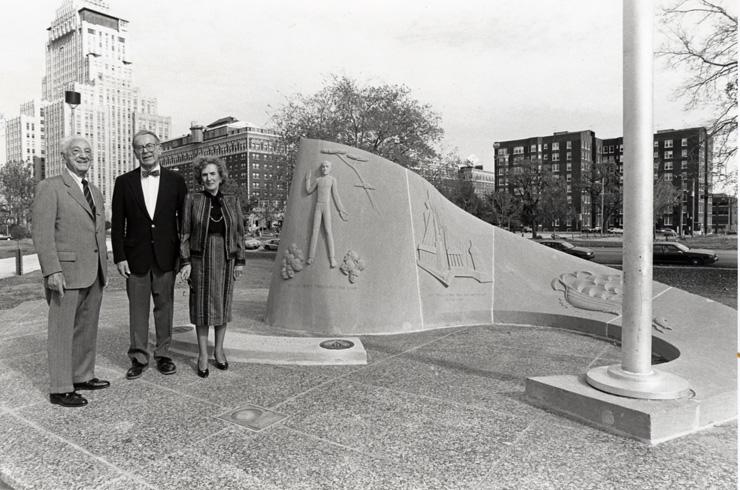
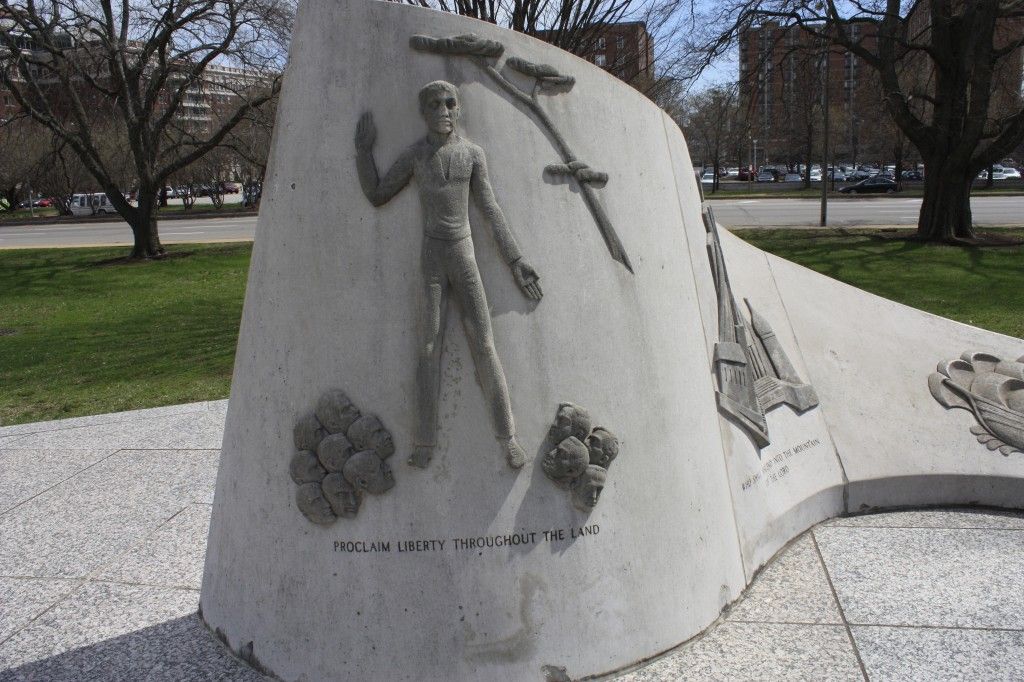
The Jewish Tercentenary Monument is located in the northeast corner of the park and is comprised primarily of a light color stone (masonry), certainly not bright white but none the less in the white family. This monument commemorates the arrival of Jewish immigrants to “New Amsterdam”, otherwise known as New York, following an attempted trip to Amsterdam in The Netherlands interrupted by pirates. This proposed casque location incorporates both our secondary unlisted culture found throughout the verse and the image, while simultaneously fulfilling Dutch culture indicated explicitly by the image and the corresponding Litany of the Jewels clue. Consider also that America was referred to as the “Goldene Medina” or “golden land” by the immigrant Jews, while the man’s attire in image 9 has golden characteristics all over it.

Notice that the stairstep design below the man’s collar in the painting is emulated by the architecture of a nearby hotel visible from the west side of the monument where the verse directs us to. Also consider that we are viewing this building at an angle, while the stair step design from image 9 is asymmetrical, emulating an angled view. This marks the third example of the “crow-stepped gable” design from the image, which is also outlined in gold three times.

Given the inherent difficulty of locating a 6-inch cube in the ground, identifying the west side of the monument doesn’t seem specific enough. It just so happens that on the monument’s west side, we have a relief depicting a group of disembodied heads which looks awfully similar to the clumps of pollen appearing on the flower of image 9. This would then act as our landmark to travel 12 paces to the west.

When looking at image 9 sideways, the negative space created by the man’s hand is vaguely reminiscent of the general shape of the Jewish memorial, with the pollen we connected to the disembodied heads appearing in a very similar location compared to the memorial. Please consider that the hand which partially forms the negative space is also representing something else (Joie De Vivre sculpture), which may explain the impreciseness of the outline. That being said, this is one of the more circumstantial and arguable connections in the interpretation.
Ambiguous shading within the flower may also offer a vague resemblance to the memorial. Given the suspiciously assembled pollen and the number of flower petals equaling the same number of paces taken from the memorial, the flower appears to offer some association to casque location characteristics, although an exact role beyond these observations is currently uncertain.
In 1989, a large scale renovation of the monument space was conducted which saw the addition of fountains, wider pathways, and a six foot tall granite base upon which the monument itself was remounted. Unfortunately, this means that the west side of the monument was compromised and the casque is no longer retrievable. Photographic confirmation of the pre-renovation conditions could shed additional light on image 9 elements although nothing to date has been discovered or disclosed.
Update 12/25/25: Upon examining historic aerial photographs from 1984 on historicaerials.com, the Jewish memorial may have had a slightly different location prior to being mounted on the granite base. As a result, the casque’s destruction during the 1989 renovation is far less certain. The casque may still be retrievable.
Amongst all 12 Secret cases, this St. Louis solution poses the only instance where the verse explicitly instructs permission seeking prior to physical investigation. I have seen enthusiasts hypothesize the motivation behind this instruction for years, while the actual explanation is fairly simple. Byron was Jewish and therefore would hold a location significant to his faith in high regard. He wants you to seek permission because to him this surrounding ground is sacred.
Considering the logistics of discreetly burying an object, this proposed casque location is in the furthest corner of the park surrounded by trees. While such a condition is not a foregone prerequisite, as supported by the Boston casque location on an unprotected baseball diamond, it does aid in further reinforcing the proposed site.
Now that we know that Montreal was never the correct application for image 9 in regard to a casque location, let’s briefly look at image 7, and the intriguing number of similarities between the two. Both images contain checkerboard patterns. Both images contain golden squares. Both images are applied to cities founded in large part on French culture. Both images incorporate references to two different cities. And both images…are connected to Montreal…
For a final St Louis solution connection, “A cloud of shifting, shining smoke” is the “Litany of the Jewel” clue given by the book for the “Opal of the lowland Gnomes”. Reportedly these clues are a direct reference to the casque location. In the late 1800’s and early 1900s, St. Louis had an incredible smog problem generated by the Industrial Revolution and an extreme energy dependency on “soft” coal. The creation of Forest Park was partially in response to these adverse environmental conditions. A particular episode in 1939 saw conditions so bad that streetlights were left on during the day due to low visibility, thusly creating “shining smoke”. This particular episode was referred to as “the day the sun didn’t shine”…emphasis on the word “shine”.
As such, “shining smoke” would provide a general reference to the host city and approximate time period of interest. The use of the word “shifting” could reference the incredibly degree of change experienced at Forest Park over the years, and the vast array of uses it has accommodated. Forest Park was home to the 1904 World’s Fair, “hosted” the first Olympics in the United States, hosts an annual hot air balloon race, included an amusement park, and is still home to the St. Louis Zoo, amongst many other things.
Considering that our litany clue references a condition of obstructed visibility…isn’t it interesting that the verse is heavily reliant on things we can’t see?
Additional Clues
-A series of mounds appear of the right side of the hat in image 9, while St. Louis was known as “Mound City”
-The geographic shape of St. Louis resembles the man’s oddly formed head
-The checkerboard pattern on the man’s hat has an alternative color scheme with brown squares instead of black squares, possibly representing our casque location as technically a part of Forest Park although separated by W Pine Dr.
-Man in image is often connected to Rembrandt who was Dutch, while Art institute found in Forest Park and built for 1904 World’s Fair has works of Rembrandt
-U-shaped neckline in image 9 matches Gateway Arch when image is flipped upside down
St. Louis Solution Pros:
-Makes sense of Japanese clues
-Applies accurate and historically significant verse interpretations
-Includes three verse context clues for associating St. Louis
-Applies all qualifying words from verse
-Explains many major visual devices as well as more subtle details in image
-Explains presence of checkerboard and asymmetrical character
-Explains why no one can convincingly apply image 9 and verse 5 to Montreal
-Applies six visual elements to a single event, difficult to dismiss as mere coincidence
-Explains leg extending beyond box boundaries and lack of box around the flower
-Incorporates strong cultural representation with both cultures applied to casque site
-Applies “abbot” acrostic
-Explains why we need “permission to dig out” only for this case
-Authenticates “litany” clue with historical significance relevant to route location
-Explains presence of interpretive devices for two different cities
-Maintains traditional image and verse pairing, supported by wed line “white stone closest”
-Explains why images appearing on man’s chest are either within a box, partially outside of a box, or include no box at all
-Cohesive theme of sports found amongst three objects appearing on man in image 9
St. Louis Solution Cons:
-“Arc of lights” interpretation is a little circumstantial
-Image lacks flashy visual devices comparable to other cases
-Obvious Montreal connections not applied to a Montreal solve
-Incorporates secondary, unlisted culture
-Many visual details unaccounted for
-Conventionally unsatisfying application of “legeater”
-Abbot Suger application is underwhelming
-St. Louis is not amongst the cities “confirmed” by Gift Giver or JJP
-Counting 11 petals on the flower seemingly neglects the partial petal
-Aspects of “white stone” interpretation are circumstantial and arguably inaccurate
2 responses to “St. Louis Solution”
-
I believe it is in St. Louis. I have a different location, but am afraid to dig and still looking for exact evidence before I try.
-
Thank you for the comment, greatly appreciated. I would however caution using the word “believe” when discussing The Secret. Byron’s answer isn’t based upon our belief, its based upon the evidence of clear human communication Byron left behind for us. If the presense of a casque was based on what people “believe”, then there would be thousands of casques scattered across America. Of course, this narrative is strictly opposed to what the community of searchers endorse, which is one major reason why this site exists in the first place. If you have to believe its right versus knowing its right, you either haven’t collected enough evidence…or its objectively wrong. A trained communicator will not make you guess what the answer to his puzzle is, its knowable pre-casque.
-



Leave a Reply