As theoretical interpretations of Secret images go, most cryptic visual devices are applied in a very uninteresting, circumstantial, one for one manner. Despite the confirmed application of wordplay or word associations, such as the Mill-walk-key rebus of image 10, or the “loop” of image five, investigators typically insist that red balls can only be red balls or trees can only be trees. We try to interpret what the images show us, but not what the images are saying. Should it not be expected that a trained communicator might find very creative and unexpected ways to visually convey intended communication? Would that not seem more puzzle-like than just generically matching things? One for one matches are certainly involved, but by no means should they be the exclusive focus.
This brings us to image 10, commonly and accurately associated with Milwaukee. Behind the enigmatic woman and her curious collection of juggled objects is a muted backdrop of four obscured images. The only immediately recognizable inclusion amongst them is City Hall. To the left is a partially out of frame domed structure. To the right is an impossibly indistinguishable sliver. And within the lower right quadrant of City Hall is a ribbed, curled object commonly interpreted as a locust. Could these vague visual devices reveal an unexpected secret hidden within image 10?

Harkening to childhood television viewing sessions of brightly colored misbehaving puppets and entertaining scenarios with educational overtones…one of these things is not like the other. Milwaukee City Hall is obscured even though there is no mistaking it for anything else, unlike the remaining three objects that are difficult to discern. Why then is City Hall obscured? Is it possible that we are supposed to associate City Hall with the other obscured objects given that they appear in the same format? Could identifying City Hall potentially help us positively identify the other more mysterious inclusions?

The first thing we can say with a strong degree of confidence is that City Hall is a focal point in image 10, suggesting we are intended to notice and apply this unmistakable device quite early in our investigation. How we are intended to apply this device is the real question, and can it serve more than one purpose? While downtown proposals incorporate proximity, general viewing, or matching the precise angle of City Hall at a proposed casque location, we are under no explicit obligation to apply this devise along the intended path.
This is further supported by image 5, which sets a precedent by incorporating the likeness of the Chicago Water Tower as an area device and directional cue, found more than a mile north of the casque location and not involved in the active solution. This example supports the theoretical premise that seeing City Hall somewhere along our route to the casque is not a forgone conclusion. However, unlike Lake Park interpretations, we should apply City Hall in some manner.

In addition, the visual presentation of background objects bathed in an obscuring haze, contrasting vivid and brightly colored objects in the foreground, is representative of separation and distance from actively involved puzzle devices. Building a theoretical framework, so far these objects are related to each other to some extent, found at a distance, and not necessarily found following the verse. Beyond subtle visual indicators, does any explicit instruction delineate their collective application? Is it possible that verse 8 may unlock this unexpected secret hidden within image 10?
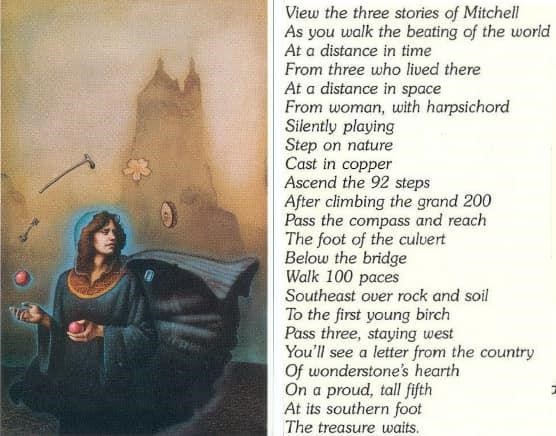
Consider the first line of verse 8 for a moment. It says “View the three stories of Mitchell”. We know from the Japanese translation of the book that “stories” is referencing the physical height of a building with differentiated floors, rather than referring to a literary work or a narrative. This would therefore effectively eliminate a proposed interpretation like the Mitchel Park Domes from contention. However, is it still possible we are meant to interpret this line BOTH ways? Pay close attention to the wording of the Japanese clue which suggests Byron’s hesitancy to firmly define “story” as a singular concept:
Line 1: The three stories of Mitchell. “(Japanese) Mitchell’s 3 stories”, but the “stories” is tricky. Is it “three stories by the novelist Mitchell”? or “Michell’s three story building.”? At first I interpreted it as the first, but Mr. Preiss (even though not clearly stating) strongly directed me towards the “three story building”, so I chose that expression for the Japanese translation.
Because the Japanese translation cannot simultaneously incorporate both meanings of the word “story”, could a compromise have been made to prioritize our starting point clue at the expense of a hidden, secondary meaning? We are told specifically that the English is the most reliable text, with the Japanese translation appearing in footnotes.
A secondary, supplemental interpretation of our introductory verse 8 line leads us to a fascinating possibility. Could Byron be acknowledging three possible “Mitchell” candidates, and subsequently three possible solutions as a result? From a simple point of logic, this line MUST reference other Mitchell buildings.
When Byron wrote the line “View the three stories of Mitchell”, did he just assume there were alternative interpretations, or did he have them in mind? A three storied structure somehow associated to “Mitchell” offers extremely finite possibilities, potentially representing an ill-advised introductory clue decisively determined with relative ease through process of elimination. In theory, if we fail to convincingly apply any other concept from the verse, we cross it off the incredibly short list and move on. With this thought in mind, is it possible Byron investigated the areas surrounding alternative “Mitchell” candidates, developing a verse of intentional interpretive overlap with his true solution? The answer to this question is a secret hidden within image 10.
For many, this theory will propose a highly unlikely scenario. Are we really meant to believe that Byron engineered multiple red herring solutions for unsuspecting investigators to fall victim to? Are we meant to believe that Lake Park, held in high-esteem by even the most experienced and credentialed investigators, is nothing more than an elaborate ruse? And yet, at what point do we set our perceptions aside and simply follow where Byron is guiding us? Chances are highly likely that a 43-year-old, subjectively crafted, unsolved treasure hunt called “The Secret” might offer unanticipated yet surprisingly plausible and prudent possibilities.
Consider that the majority of elements incorporated into verse 8 are quite common and easily duplicated on alternative pathways. Devices such as nature, copper, rocks, trees, dirt, bridges, or culverts are in regular and plentiful supply. “As you walk the beating of the world” is open to a degree of interpretation and can thusly be applied or misapplied in countless formats. Certain lines are only applied with qualifying terms conveniently absent, such as “On a proud tall fifth” or “To the first young birch”. In the case of a line like “From woman, with harpsichord”, it could have been written BECAUSE it overlaps with multiple locations. In addition, given the considerable interpretive liberties applied, in some cases manipulating the source material beyond recognition, investigators eager to justify proposed answers by any means necessary needlessly deceive themselves.
One minor discrepancy to consider is that while there are “three stories of Mitchell” identified, there are in fact four objects. One possible explanation is that there are three false solutions identified and one true solution. But then there really aren’t three “stories”, there are four. Or perhaps the number of candidates is irrelevant and the puzzle is simply identifying a collection of 3 story Mitchell buildings. Whatever the case, this criticism is minor, and fails to undo the remaining evidence.
If the “three stories of Mitchell” refers to a collection of possible solutions, then based on the verse we are instructed to “view” them. However, this does not require us to physically visit each location. Instead, we can “view” cryptic devices embedded in the background of image 10 each alluding to a separate answer and unlocking a secret hidden in image 10.
City Hall theoretically serves as a gateway device for deciphering the visual evidence of this devious deception. On the left edge of City Hall, just above the flower, is what appears to be a backwards, upside-down number three, further implicating an explicit association to the “three stories” line.

Since Milwaukee City Hall is not intended to lead us downtown for casque retrieval, it already serves as a strong red herring as it can be seen from so many locations. The downtown area hosts both the Mitchell building and the Wisconsin Club, formerly known as the Mitchell Mansion. Either location could serve as the starting position for a red-herring solution. That’s one.
Next, found at the bottom right edge of City Hall in image 10 is a half-moon like object commonly associated with a locust representing Locust Street Ravine Trail at Lake Park. This does indeed represent Lake Park…but not for the reason people believe. This image serves a dual purpose, appearing as a locust until a closer examination is conducted. I am personally shocked that this find has not been previously advertised. When looking more closely at the figure, there is far more information to perceive than believed at first glance.

Focusing primarily on darker segments and contours, the “locust” is complimented with additional information. The darkened, bulging vertical contours on the right imply a mounted individual. Instead of a locust, the same image appears to be the tucked head of a beast with straps just beyond the base of the neck, connected to a larger body slopping downward beneath the vertical figure. While appearing in a distorted and incomplete form, its likeness can be attributed to the equestrian statue of General Wolcott at Lake Park. In further support of this position, a closer investigation of the space immediately above what would constitute as the horse’s backside, we can faintly decipher the letters “E”, “r”, and “a” preceding a collection of inconclusive and possibly incomplete characters, while General Wolcott’s first name is Erastus. That’s two.

While visual analyses of image 10 commonly fail to comprehensively incorporate purposeful devices and details in a compelling way, I have not once witnessed any attempt to explain the domed structure on the far-left edge of the image. It’s identity is illuminated when the correct solution is applied, representing a secret hidden within image 10 in plain sight. It is intended to resemble St. Josephat’s Basilica in Lincoln Village on Milwaukee’s south side, and is a part of what I have personally dubbed The St. Stephen’s solution. Click here to see that solution explained in its entirety. That’s three.

The remaining object seems unfairly incomplete. How in the world are we expected to positively identify the elusive sliver with so little information? I’m not entirely certain that Byron ever expected anyone to figure this out, and without instant access to nearly every square inch of Noth American civilization, maybe we wouldn’t have. But what is easy to perceive as a limitation…may in fact be an advantage.
We see a relatively straight object with intermittent, variable curves, previously likened to the hilt of a dagger on PB works. What would a dagger have to do with Milwaukee? What’s similar in design to a dagger? What about a streetlamp? Is there a proposed verse 8 solution which incorporates a streetlamp? Yep…its Montreal…at the George Stephen House (notice the “Stephen” part of that equation).

I anticipate that some if not most will find this difficult to accept or even entertain. Whatever conclusion one reaches, it should be based on evidence and logic versus perception and preferential beliefs. Looking at Lake Park and verse 8 Montreal, by far the two most popular applications of verse 8, we arrive at something of a conundrum. While both proposed solutions offer comparable claims, at least one of those is wrong.
Neither instance offers flawless interpretation or unquestionable communication throughout the entire investigative process, instead presenting intermittent credibility and a plethora of gaping holes in logic any piercing enthusiast would be envious of. How do we confidently endorse one proposal and not the other given how similar they are and how easily each fall victim to comparable inadequacies? For the same reason, how do we confidently contend that one proposal is the product of a coincidence and not the other? If you are willing to believe that one of these casque location candidates is a red herring, why would you be unwilling to believe they both are? We can’t decide how Byron assembled his puzzles through personal determination, but we do choose our level of willingness to perceive and accept his one of a kind free will choices.
When assessing the hypothetical Milwaukee interpretations anchored by the three haze covered artifacts, a common correlation emerges. In each case, we have a sample of visual devices supporting the respective proposals. The millstone, locust, red balls, and outline of a lion support Lake Park. City Hall, the emulation of Solomon Juneau’s hand from a relief bordering downtown, and a bell silhouette referencing the bell at City Hall named for Juneau, all support Downtown Milwaukee solutions. The St. Stephen’s solution is supported by…well…everything, with a few notable inclusions being the walking stick representing four walking references all found in close proximity and geographically represented in the image, and the walking stick pointing at the jewel while the casque location is in the “Walker’s Point” neighborhood.
One final secret hidden within image 10 comes courtesy of Montreal. If image 10 references a Montreal application of verse 8, should we expect additional visual validation comparable to the other three objects? There remains one device, that up until know, serves no purpose beyond apparent misdirection. The device in question is the out-stretched hand of the woman uncannily emulating the relief of Solomon Juneau at Juneau Park on the eastern edge of downtown Milwaukee. Notice that the depiction of Juneau’s right hand and arm including the possession of an object, as well as general posture, also emulates image 10. The right hand in image 10, mirroring the right hand of Juneau, contains a silhouette of a bell, while the bell at Milwaukee City Hall is dedicated to Solomon Juneau. Solomon Juneau…was a French Canadian…originally from a small village near Montreal…

Leave a Reply