Serving as a microcosm of modern society, the online sphere of Secret investigations is populated by a wide range of belief patterns not strictly the result of available information and logical deduction, but rather the pervasive nature of human perception and underlying motivations thereof, persuaded in some cases by the frequency at which a belief is transmitted, or the confidence by which it is conveyed.
Here are the five most common misconceptions regarding The Secret.
5. Casques will only be found in parks

Despite the widespread popularity of this belief, amongst the many common misconceptions regarding The Secret, this one is plainly contradicted on the very first page of The Secret: A Treasure Hunt. The introductory paragraph explicitly qualifies that casques can be found “in your city OR your local park”, clearly differentiating the two possibilities.

Subsequently, under what objective pretense do we disqualify non-park casque locations? Could arbitrarily eliminating this possibility actually inhibit intended successes? What happens when you insist a casque must be buried in a park despite available and reliable information to the contrary, limiting your investigation by this preconceived qualifier and rendering an exclusive focus in the wrong places? I know its popular to blame Byron for 43 years of futility, but in reality, the single largest contributing factor of constant and perpetual failure is user error…not Byron.
4. All cases are the same

A related argument is the idea that a “trend” observed from the three solved cases either suggests or unilaterally indicates the continuation of that trend. For example, some will argue that because the first three casques are all found in parks, all nine unconfirmed cases must conform to the same standard. We use these subjective observations to assert and assume uniformity amongst the nine unsolved cases, in particular when arguing against non-park casque locations or new ideas that interfere with preferred conclusions.
This application of a “trend” is quite common and concerning, substituting a peculiar and unfounded assumption for listening to Byron’s communication or intellectually forming viable possibilities. While a perceived trend may be worth investigating, it ultimately indicates nothing. As a subjectively crafted creation goes, trends end and begin at Byron’s discretion. We have numerous instances of trends terminating at unpredictable intervals, including the infamous geographic coordinates represented incompletely in image 12, while entirely absent in image 10. So, if a trend can end after 10 cases, why assume any reliability?
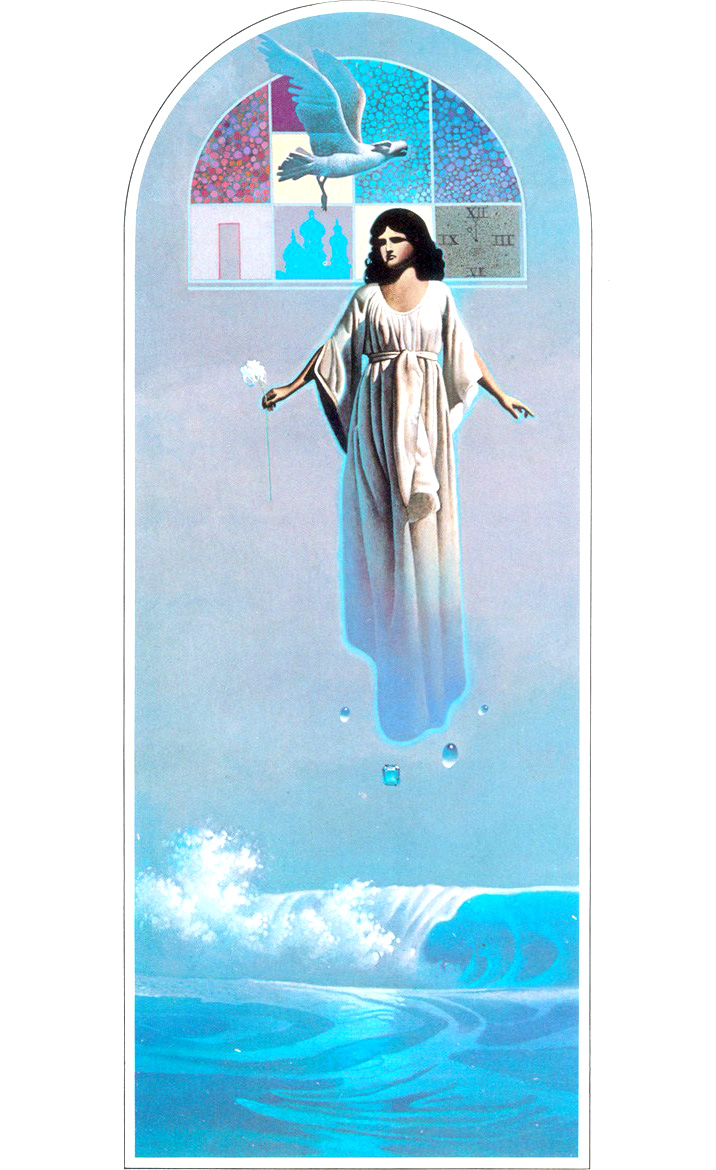

In addition, 5 of 12 verses include quotations, 3 of 12 verses make no mention of the casque or burial site, 5 of 12 paintings include time pieces, 7 of 12 verses use directional cues, 2 of 12 verses reference a book title, and so on. As you can see, the available “data” we have concerning “trends” is all over the map. So how do we rely on “trends” to tell us anything when the trends available to measure are unreliable?
Based on the perception of “trends” and “similarities” amongst the confirmed cases, it is often argued that any proposed answer must exclusively conform to the characteristics of the three confirmed solves. However, this belief is immediately compromised by evidence from twenty years ago. Why must unconfirmed solves conform to confirmed solves when the confirmed solves don’t conform to themselves? Amongst the common misconceptions regarding The Secret, this one is compromised immediately by readily available information.
The Chicago and Cleveland cases, which were the first and second cases solved respectively, are nothing alike. Chicago is a linear adventure through downtown Chicago, whereas the Cleveland case is a single location solve in the suburbs. The Chicago case has arguably little to do with the assigned immigrant culture, whereas Cleveland takes place within the Greek Cultural Gardens. Chicago uses multiple monuments as puzzle devices, whereas Cleveland focuses primarily on architectural features like steps, columns, walls, and blocks. The Chicago casque was found in a random section of park property, while Cleveland was in a planter. The Chicago verse identifies our casque location landmark in the middle of the verse while the Cleveland verse is mostly out of order and does not include one defined landmark but rather a series of characteristics. From beginning to end the Chicago verse represents a physical path twice as long as Cleveland.
If we throw Boston into the mix, it takes place over roughly 2.5 miles, few can agree upon a clear verse interpretation despite casque retrieval, visual references comparable to the first two solved cases are virtually non-existent, it leads to a casque site on a baseball diamond, relies on outside historical material versus simple onsite matches, does not appear to include the geographic outline of Massachusetts, incorporates the word “Boston” in the image, and requires patronizing the local transportation system. How is this ANYTHING like Chicago or Cleveland?
I could keep going. So why are demands for inter-puzzle uniformity rampant despite common knowledge that refutes such a position, and how should we view following “trends” when this analysis clearly illustrates how such an unwarranted standard would have stunted historical successes if applied?
There is really no shortage of reasons why assumed uniformity is objectively invalid. Byron has specifically stated that each case possesses a varying degree of difficulty, making blanketed uniformity unlikely to down-right impossible. JJP has said that no two puzzles can be solved through identical methods and that there is no repeating device for universal decoding. JJP as stated that the municipal identity of a Secret image is not always “obvious”. JJP has said that some cases are image heavy while others are verse heavy. Do these statements lend themselves to uniformity or differences amongst the cases?
Ironically, some of the most common proposed solutions fail to conform with this standard of inter-case uniformity. Lake Park interpretations fail to apply any device from the image over the first nine lines of the verse, deviating from Chicago and Cleveland. Both Boston and Roanoke appear to incorporate distances far longer than Chicago or Cleveland. Many common proposals utilize devices not exclusively interpreted through ground level information, such as associating the St. Charles Hotel in New Orleans with verse 2 based on a quote from the book Abroad in America, which once again defies uniformity with Chicago and Cleveland where all verse clues are simple on-site matches. And why in the world do we feel good about applying the name of a New York City novelist, with the wrong spelling mind you, to a park in Houston Texas?
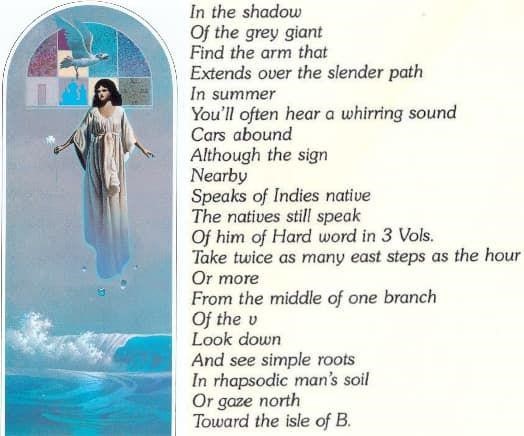
Or look at the commonly contended solution for Roanoke Island. Line four of verse eleven references “the land near the window”. This clue is almost exclusively connected to a shape in image three resembling Roanoke Island in North Carolina, etched within a stone wall near a window. Our ability to solve this specific verse clue does not rely on a ground level connection or map information like any confirmed interpretation preceding it, but instead requires the application of an image 3 observation for complete context. Therefore, this interpretation is problematic when applying assumptive uniformity to confirmed cases because in no “confirmed” instance does a clue from the verse require unique information from the image to interpret accurately.
The same could be said for interpretations of “twice as many steps as the hour” from verse ten. Why then is this clue interpretation not disqualified by the same standard many other clue interpretations are disqualified by? Given these examples, why would anyone put stock in so-called trends or universal uniformity, and why are commonly asserted standards so inconsistent and erratically applied? These common misconceptions regarding The Secret succeed in perpetuating falsehoods and stifling authentic discoveries.
3. Byron made the puzzles “easy”

In at least one promotional article introducing the quest for fairy treasure to “new world” inhabitants upon the book’s original 1982 fall release, Byron expressed anxiety over the possibility of instantaneous casque retrieval prior to adequate financial returns as a result of the puzzles potentially being “too easy”. Some will apply this commentary as evidence of “easy” puzzles, more specifically qualified as a heavy reliance on straight forward, one for one interpretations and “transitory” devices, meaning common and often temporary things such as trees. This inspires the philosophy that the application of “simple” interpretations, i.e. superficial face value matches, makes the puzzle “less complicated”, when in reality this theoretical strategy makes the process infinitely more complex and hopelessly ambiguous. Such a perceived condition has created one of the common misconceptions regarding The Secret.
While Byron expressed anxiety over the financial fate of his creation and his aptitude for puzzle creation, we have no confirmation how that fear may have manifested, if at all, regarding the structure of the puzzles. Regardless of where it may originate, the idea that referencing commonly found things makes the puzzles themselves “simple”, applying a superficial “check the boxes” sort of approach, is beyond absurd. How does referencing common and even relatively temporary things, with no further in-puzzle confirmation of their inclusion, create easier to solve puzzles? How does endorsing literally thousands of “possible” clue interpretations based on the standard of simple one for one matches make the puzzles “easy”?
Why does Byron’s fear not alternatively suggest he made incredibly “clear” puzzles with incredibly confirmable answers in which “transitory” references are used sparingly and additionally confirmed to some capacity, as evidenced by both the Chicago and Cleveland cases? Would Byron’s fear that the puzzles were “too easy” really lead him to make “easy” puzzles, or would it inspire him to make harder ones?
Of further note is the confirmation from Byron that the twelve cases offer a variable degree of difficulty. He said that the more valuable gemstones necessitated harder puzzles. The question becomes, how do we define easy and hard…and how did Byron? How do you make a harder puzzle with a similar brand of superficial matching across all twelve cases? Can the difficulty increase while the clarity of interpretation remains uncompromised?
When someone says that the puzzles should be “simple” or “easy”, what does that really mean? We often confound the ease at which a claim is made with the ability to discern evidence to warrant that interpretation. Generating an easily communicated claim, and indicating why that claim is valid with information from the puzzle, are two completely different things. An endless collection of plainly worded and technically accurate claims does not make the puzzles “easier” to interpret…it makes them harder. Investigators focus the majority of their energy on the “what”, with seemingly no obligation to address the “why”. The explanations we do receive often have very little relevance to Byron’s puzzle.
While perpetual failure over four decades should trigger suspicions of flawed perception and faulty assertions regarding these puzzles, the pervasiveness of subjectively compelling ideas persists, even in the face of readily accessible and logical alternative possibilities. Unfortunately, many people would rather follow easily identified, common misconceptions regarding The Secret then find success in unanticipated places.
2. The city/image pairings have been “confirmed”

This is quite possibly one of the most aggressively asserted, common misconceptions regarding The Secret, found within the online sphere of Secret investigations, depending of course on where you are and who you are talking to. It should be separately noted that several of the casque cities themselves have been “confirmed” by official channels, which includes Milwaukee, San Francisco, Houston, Montreal and New York City. However, these confirmations exclude official endorsements of image and verse pairings.
To further reinforce the ridged application of traditional city assignments to corresponding images, an interview with “The Secret” artist John Jude Palencar (An Evening with John Jude Palencar – The Secret treasure hunt, YouTube) is regularly sited in which vague statements are generically referenced and confidently asserted as a “confirmation”, while an actual quote of Mr. Palencar’s precise words are predominantly and conveniently absent.
In the afore mentioned interview, Mr. Palencar states that “They seem to be going in the right direction for the right cities for the right image” (15:50) and “I think they discerned the general geographical location” (16:04). So, what do those statements mean, and why are we interpreting indecisive “I think” and “They seem” statements as an indisputable “confirmation”, defying the dictionary definition of that concept? On paper, these comments are at best an informed opinion based on an undisclosed level of information 43 years removed.
It is also important to qualify the original question related to these answers. JJP was asked if Roanoke, Charleston, St. Augustine, and New Orleans had casques. Although he was never asked if the remaining nine images are associated with the correct cities for the purpose of casque retrieval, this is exactly what is interpreted from his response. So, was JJP answering the question he was asked or not?
In addition, Mr. Palencar mentions how many clues he has forgotten (33:08, 35:05), was unable to immediately confirm if four cities had casques at all as the result of uncertainty (14:55), explained that Byron restricted information flow to necessary components potentially rendering Mr. Palencar’s knowledge of each case incomplete (23:10), and states definitively that he “just doesn’t know” where the treasures are (33:02). Furthermore, and quite ironically, JJP himself specifically encourages people to investigate alternative city assignments (13:38), characterizing that process as “activating people’s brains”. Mr. Palencar also states quite curiously that not all city assignments are “obvious” (15:54), which seems contradictory to the premise that included coordinates (and a slew of compelling complimentary evidence) can only lead to the casque city versus serving an alternative purpose.
Why does it seem only some of JJP’s statements are being perceived while others are ignored entirely? While the words of Mr. Palencar are arguably insufficient to definitively project the attributed claim, can we alternatively apply in-puzzle evidence potentially compromising the prevailing perception? As these common misconceptions regarding The Secret go, our confidence and attention are often misplaced.
What often gets completely lost when attempting to solve these puzzles is that we have everything we need without outside intervention. After such an extended period of time predominantly devoid of definitive resolution, reliance on external information has intensified. We are attempting to solve Byron’s puzzles while simultaneously diminishing their importance. Many assert that without the man himself, all hope is lost. This is simply not the case. We still have Byron. We have his verses and JJP’s paintings. We have clear communication from a trained communicator illuminating a singular, definitive answer. When we decide to stop removing Byron from the equation, we may experience more successes solving HIS puzzles.
In acknowledging this, we must also acknowledge that this is a subjective puzzle with an objective answer. As a free-thinking individual, Byron could devise these puzzles in any manner he chooses, including the incorporation of devious misdirection, and exploiting predictable human behavior by eluding to “obvious” devices while applying them to an unpredictable purpose. It is assumed for example, that if an image includes clear references to a particular city, that this “proves” that the image leads to a casque in that city. However, given a variety of factors, a particular geographic location may be referenced to serve a purpose alternative to directly leading to a casque. Assuming that visual references to a particular city can ONLY lead to a casque in that city, is amongst the common misconceptions regarding The Secret that disregard the dynamic of a subjectively crafted puzzle.
Cities do not exist in a bubble. They instead have interconnected histories. For example, the naval shipyard in New York City either produced or accommodated several notable vessels including the USS Maine and the USS North Carolina. The Wickquasgeck trail was a prominent trading route which extended from New York City into Montreal, now known as Broadway. Long-time New York politician FDR viewed the 23rd performance of the Lost Colony play at the Fort Raleigh national historic site on Roanoke Island in 1937, commemorated by an inground marker. Then imagine what might happen if Byron included references to championship matches in team sports. This is of course a small sample of significant historical connections between notable municipalities.
Think about this for a moment. Image 7 unquestionably incorporates numerous references to New Orleans including but not limited to geographic mirroring, geographic coordinates, and convincing although circumstantial connections to Preservation Hall and Louis Armstrong. However, with those “obvious” connections come a lot of questions. Why do the coordinates for New Orleans include a seemingly unrelated third number? Why is the word preservation flanked by arrows pointing at it from either direction? Could the appearance of a checkerboard as the image backdrop offer symbolism of opposing forces or distinct personalities? Could a white mask representative of a “black” man (Louis Armstrong) indicate an unexpected hidden identity? These are certainly not the only inquisitive observations available to make. Something to think about…

The point is, interpreting Byron’s puzzle does not have to be nearly as binary as people make it, which could help explain 43 years of futility. Don’t be afraid to test conventionally unorthodox possibilities. We make fair observations of convincing elements, then assume how those devices are meant to be used. If we find numbers that correspond to the coordinates of a particular city, we enthusiastically conclude that those numbers can ONLY be used as coordinates for the casque’s municipal resting place versus just a reference to that location, while numbers also serve a wide range of unrelated uses.
It’s interesting to me, an apparent reference to the Statue of Liberty in image 12 can only lead to a casque in New York City, and yet the first name of an author in New York City can be applied to the Houston solution because it matches a local park despite no direct relationship, and despite a spelling discrepancy. That seems like an uneven standard. Why are Byron’s choices limited to our perceptions and sensibilities? It’s amazing how so many “clear” and “obvious” clue interpretations have resulted in dead ends…over 43 years…in a subjectively crafted PUZZLE…called THE SECRET. Not only are we beating a dead horse, but it has been pulverized into a fine dust.
The position that city and image associations are “confirmed” appears just as selectively discerned as most aggressively asserted beliefs. While excluded as a conventional casque city, St. Louis has been long suspected of hosting a case of The Secret, and for good reason (see the St. Louis solution here). A Q4T forum user named Johann shared email correspondence with Byron that “confirms” St. Louis as a casque city. While some contend this may mean St. Louis Cathedral in New Orleans, a little critical thinking dispels such interpretation. We know that this user contacted Byron with a proposed St. Louis solution, so why would Byron respond to a wrong solution in a wrong city by covertly revealing a specific location in an entirely different city?
In light of acknowledging this information, why are JJP’s “I think” and “they seem” statements qualified as undeniable confirmation, but clear communication from Byron himself is not? For those who believe that a belief in a St. Louis casque is merely “wishful thinking”, let’s remember that “wishful thinking” goes in both directions. Houston was also “confirmed” by Byron through email correspondence. So how can Houston be “confirmed” but St. Louis isn’t when applying the same variety of evidence? Many of these common misconceptions regarding The Secret are often passionately defended and aggressively enforced.
All of this being said, the theoretical possibility of alternative city/image pairings does not nullify ALL pairings. Cautiously apply this principle on a case-by-case basis as the evidence warrants. I see both extreme ends of the spectrum. While one school of thought unilaterally rejects the faintest possibility of alternative image/city associations (even confirmed cities applied to different images), the other endlessly applies incredibly loose connections to virtually any location imaginable. If only we could meet at a happy medium…
1. Only a casque proves an answer

This well-meaning proclamation is by far and away the single largest contributor to failed investigations. Asserting that a proposed solution is exclusively validated by the retrieval of a casque carries with it a number of loaded implications. If this is true, then Byron’s one and only answer is indistinguishable from a coincidence, leaving the door open to millions of possibilities.
It means that a literary publisher with a master’s degree in communication is incapable of competently communicating the answer to his own puzzle. It means that the “answer” to the puzzle isn’t really an answer, but rather loosely assembled set of correlations predicated upon an ultimately random guess, leading to a 6in box…up to 3 and a half feet in the ground…somewhere across the 9.6 million square miles of North America. It means that you can theoretically “solve” a puzzle you never heard of. Does that really make sense to people? Of all of the common misconceptions regarding The Secret, this has quite easily caused the most investigative futility.
While Byron tells us we can potentially figure out the resting place of a casque without even leaving the comfort of our home, modern wisdom demands the presentation of a casque before any claim of “figuring” can be made. It seems unfathomable to contend that Byron constructed a puzzle with no discernable answer, requiring interpersonal correspondence in the event that rocks, dirt, trees, and bridges are all found in the same place while no casque is found.
For many Secret commentators, a casque is the only acceptable form of evidence or “proof” of a “solution”. This framework is haphazardly intended to counter-act the relentless nature of proposed Secret theories or “solutions” collectively numbering quite easily in the hundreds if not thousands, commonly the product of unconfirmable subjective interpretations or random guesses in a generic matching game versus interpreting clear communication or attempting to actually “solve” anything. Every random, loosely associated idea under the sun, often in direct contradiction to clear communication from the puzzle, is asserted as either as “the” solution, or a potential solution despite our ability to rationally debunk most claims as inaccurate products of coincidence and selective evidence collection. While it is well-meaning to an extent, attempting to apply this “only a casque mentality” is further contributing to a needlessly inflicted whirlwind of uncertainty and confusion rather than alleviating it.

How is it that a philosophy built upon producing results has thus far failed to produce any and yet receives a misguided following? Only a casque proves a solution, but the solution for too many proposed solutions has neither reduced them nor decisively produced more casques. Ironically, the “solution” for having too many “solutions” has now become part of the problem. While we struggle to solve “The Secret”, we think we can solve a product of human psychology far more complex and convoluted than anything Byron ever concocted. That seems rather inconsistent.
If only a casque proves an answer, what proves that the philosophy of “only a casque” is useful, helpful, or even fair? Ironically, the basis for claiming that no proposed solution is undoubtedly differentiated from a coincidence without a casque…is itself an opinion, and not an easily supported one with circular reasoning providing the primary intellectual crutch for an otherwise unstable position. In that same spirit, investigators applying Byron’s puzzles in manners never intended is not “proof” that only a casque proves an answer.
What this philosophy directly accomplishes more than anything else…is suppression. It is a tactic by which to blindly and effortlessly suppress proposed ideas regardless of objective validity or the viability of investigative frameworks. It encourages people to assume and theorize rather than investigate, analyze, and deduce possibilities down to a more reasonable pool. Like many sectors of society, people are not being encouraged to think critically, contributing to a collection of common misconceptions regarding The Secret.
Ironically, if you explain with specific evidence why a proposal is wrong in the spirit of finding casques and real answers, that often makes you a monster, but if you blindly believe that all proposals are equally wrong without understanding any of them, you are a hero. The philosophy that requires zero effort or understanding proves you value all “solutions” equally and benefits the common goal of uncovering casques??? I don’t understand that. Doesn’t Byron decide which answers have value related to finding his casques?
Many investigators are motivated by justifying their answers rather than finding Byron’s. When challenging interpretations on the basis of dictionary definitions, universal communication standards, accuracy compared to the source material, and in puzzle confirmations, the term “superiority” tends to rear its ugly head as a derogatory indictment. To many, reporting universally accessible facts and logic indispensable if organizing an independently solvable puzzle, indicates an air of intellectual superiority. If the presented positions hold unrelenting validity, does this not reflect the “superiority” of Byron’s one true answer rather than an adverse behavior or attitude perpetrated by the reporting individual? Why wouldn’t Byron’s answer be “superior”?
Here’s what I find fascinating. People often contend how easy these puzzles should be. We are reminded that “The Secret” was made for kids and families (this characterization is actually false but this is what many claim). And yet, claiming to have an answer is an expression of intellectual superiority because only a casque can prove that. This means, that the answer to the puzzle, is not universally accessible. So which is it? The problem is, we are reacting to a symptom of a problem. We hear a cough, so we administer cough medicine, which doesn’t necessarily address the root condition. In this case, the “cough” is getting worse and the goal remaining unresolved does nothing to motivate course correction.
The reality is, we don’t need a casque to know which answers are right or wrong. What we need is a consistent set of criteria, instituted honestly and fairly based on the qualifiers of Byron’s puzzle, reasonable communication standards, and logical deduction, to measure the validity of any proposed solution. In this regard, all pre-casque answers are not “equal”.
For example, when verse says “giant pole”, and we apply a physical pole that fails to exhibit unusual size, like a standard size flagpole or streetlight, or does not directly relate to the word “giant”, this is not a valid interpretation. When our use of the word “culvert” incorporates an open-air drainage ditch that fails to meet a dictionary definition, this is not a valid interpretation. When our definition of something “tall” is actually something short but found at a higher elevation, that is not a valid interpretation. Ascribing the passage “At stone wall’s door” to an open wooden archway with no door is not a valid interpretation. When we render words or entire lines “unnecessary” to make an interpretation “fit”, this action completely defeats the intended purpose of those linguistic inclusions as deductive qualifiers. These are the types of interpretations we should be either adjusting or eliminating. Instead of eliminating misinformation and common misconceptions regarding The Secret, we often perpetuate them instead.
A key element perpetuating mass confusion lies in conflating the casque with the answer. The puzzle and its subsequent answer represent a completely separate entity in relation to the casque. The puzzle leads you to the casque and the casque is your prize. The casque itself is not the “answer”, which once again disregards common sense and dictionary definitions. If applying these socially conditioned misnomers, one can contend that it is fully within the realm of possibility to solve Byron’s puzzle…without ever once hearing about it. This means, someone who accidentally digs up a casque is credited with “solving” a puzzle. Say whhhaaaaa?????
Amongst other things, this “only a casque” philosophy inadvertently diminishes the importance of devices and communication within the puzzle while overstating the role of the casque. In reality, the casque is your prize, and the puzzle is what gets you there. How do we find a casque if every pre-casque answer looks the same and every answer is equally valid? Does that not imply that it makes no difference whether “our” answer has any relation to Byron’s puzzle? If all pre-casque answers are the same, then answers that don’t lead to a casque look the same as answers that do.
So, something that isn’t a valid answer functions exactly the same as something that is a valid answer, as communicated by a professional communicator??? How can true answers and false answers be perfectly equal??? How can we call them answers when they don’t answer anything? It renders the content of any given solution entirely arbitrary. You mean to tell me that we need a valid answer to find a casque while no answer is valid without one? Talk about your ultimate catch-22.
Imagine that you lived in a desert, and didn’t believe in trees. Does the fact that you can’t find a tree prove that they don’t exist? What if someone tells you that they do exist and how to find one? Would you investigate their claim, or believe what you have always believed while the trees exist in the one place you refuse to look? Now apply this idea to The Secret and a knowable pre-casque answer. Could more people not be finding casques because they aren’t looking for answers that look different? How can you expect to find something you aren’t looking for, or aggressively deny the existence of, while antagonizing those who are trying to help you find it? This of course can be applied to more than just a silly treasure hunt…

Leave a Reply